
These lectures were given at the 1996 Stanford Summer Institute. This HTML version has some format problems and is missing references.
A PDF version is also available with references (1.1 MB).
Wesley H. Smith*
Physics Department
University of Wisconsin, Madison, WI 53706 USA
ABSTRACT
These lectures describe QCD physics studies over the period 1992 - 1996 from data taken with collisions of 27 GeV electrons and positrons with 820 GeV protons at the HERA collider at DESY by the two general purpose detectors H1 and ZEUS.
The focus of these lectures is structure functions and jet production in deep inelastic scattering, photoproduction and diffraction. The topics covered start with a general introduction to HERA and ep scattering. Structure functions are discussed. This includes the parton model, scaling violation, and the extraction of F2, which is used to determine the gluon momentum distribution. Both low and high Q2 regimes are discussed. The low Q2 transition from perturbative QCD to soft hadronic physics is examined.
Jet production in deep inelastic scattering to measure as
and in photoproduction to study resolved and direct photoproduction is
also presented. This is followed by a discussion of diffraction that begins
with a general introduction to diffraction in hadronic collisions and its
relation to ep collisions and moves on to deep inelastic scattering,
where the structure of diffractive exchange is studied and in photoproduction,
where dijet production provides insights into the structure of the pomeron.
_______________________________
*Supported by DOE Contract DE-FG02-95ER40896.
The H1 and ZEUS experiments at the HERA ep collider, located in the DESY Laboratory in Hamburg, Germany, observe interactions of 27 GeV electrons with 820 GeV protons. The study of electron proton collisions at HERA is but the most recent in a long and productive series of investigations begun at Stanford by R. Hofstadter in the '50s. The results obtained in t-channel (momentum transfer) investigations have provided much of our present knowledge of the structure of the nucleon as well as several fundamental discoveries. Among the milestones are:
i) Proton and neutron form factors. The measurement of the dipole form factor led to the search and discovery of the r, w , etc.
ii) The two neutrino experiment, which established lepton flavors.
iii) Bjorken scaling, an entirely experimental discovery, which gave reality to the hitherto imaginary quarks which had been used empirically to successfully classify the resonances.
iv) Measurement of the properties of the quark constituents. The experimental verification of the number, charge, spin and momentum of the constituents established their identification as quarks and predicted the existence of the gluon.
v) Discovery of prompt leptons produced in neutrino interactions indicating the production of a new quantum number by the weak interaction
vi) Discovery of the neutral weak current in Neutrino-Nucleon
collisions.
Two recent important milestones from the H1 and ZEUS experiments at DESY are:
vii) Observation of the strong rise of the structure F2 with decreasing x, attributed to a singular gluon momentum distribution in the proton at low x.
viii) Observation of deep inelastic scattering events characterized
by a ``large rapidity gap'', attributed to diffractive scattering of the
virtual photon from proton, proceeding through the exchange of a pomeron.
The study of these events yields information on the flux of pomerons in
the proton and the structure of the pomeron itself.
The size of a target feature that can be distinguished in the scattering process is inversely proportional to the square of the four-momentum, Q2 transferred to the object being probed. Thus the ability to resolve smaller features requires higher momentum transfers. The construction of the first ep collider (HERA) provides a window to this physics at center of mass energies of 300 GeV, as compared to 30 GeV reached in fixed target experiments. This has brought about a new era in the physics of lepton-nucleon scattering, in which both Q2 and energy transfer n are increased by two orders of magnitude, (equivalent to a fixed target experiment with a 52 TeV lepton beam). Viewing the collisions at HERA in the Breit Frame, where the quark reverses upon impact with the virtual photon or boson, the interactions resemble those found e+e- colliders, but with energies greater than LEP200.
The HERA collider was commissioned with first ep collisions in the Fall of 1991. First luminosity was observed in the H1 and ZEUS detectors at the end of May, 1992 with 26.7 GeV electrons and 820 GeV protons. Since then there have been four successful data runs, in the summer and the fall of 1992, from June to November 1993, from May to November 1994 and from May to December of 1995. Another run began in July 1996 and is scheduled for completion in December. H1 and ZEUS have had similar data exposures. The summer '92 run collected about nb-1 the fall run about 27 nb-1 and the '93 run about 550 nb-1. During 1994 ZEUS collected about 800 nb-1 with electrons. HERA then switched to running with positrons to increase the luminosity and ZEUS collected about 4.5 nb-1. In 1995 ZEUS collected more than 7 pb-1 of luminosity with positrons.
Deep inelastic scattering (DIS) at HERA typically involves the exchange of a virtual photon as shown in Figure 1. The kinematic variables are defined as:
s = (k + P)2 = center of mass energy
Q2 = -q2 = -(k-k')2 = (momentum transferred)2
where x is the fraction of the proton's momentum carried by the struck
quark and y is the fraction of the electron's energy lost in the proton
rest frame. The topology of a DIS event is shown in Figure 2, illustrated
with a ZEUS event in Figure 3. The electron and the current jet from the
struck quark are observed in the central detector, while the proton remnant
travels unobserved down the forward beampipe in the proton direction.
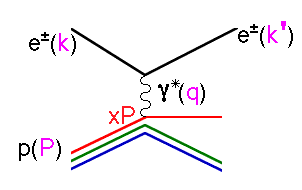 Figure
1. A deep inelastic scattering event
Figure
1. A deep inelastic scattering event
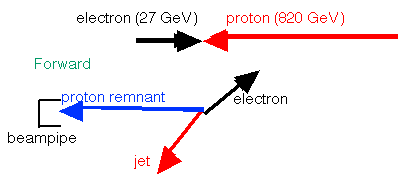
Figure 2. Topology of a deep inelastic
scattering event at HERA.
The reconstruction of the x and Q2 of DIS events is determined from the energy and angle of the scattered electron (Ee´, qe´) and the energy and angle of the current jet (Eh,gh). Only two of these four measured quantities are required to reconstruct x and Q2. For example, in terms of the scattered electron energy and angle (Ee´, qe´), we have:
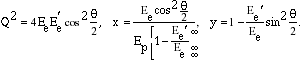
The reconstruction methods using various combinations of the variables Ee´, qe´, Eh, and gh have different responses to detector effects and vary in accuracy for different kinematic regions. The optimal reconstruction method, called the PT method, provides the best performance for the full kinematic range using all four variables, conservation of E - Pz (see section 2.1.1) and PT balance between the electron and current jets.
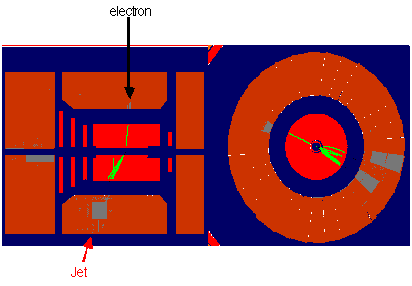 Figure
3. A deep inelastic scattering event observed in ZEUS with Q2
= 1600 GeV2.
Figure
3. A deep inelastic scattering event observed in ZEUS with Q2
= 1600 GeV2.
Photoproduction is not only a large source of background to DIS events, especially at high-y, but also is the source of many interesting physics results that will be discussed in section 2.3.3. Photoproduction in ep scattering occurs when the electron is scattered at very small angles (q < 1.0_) and Q2 is very close to zero (Q2 < 0.2 GeV2). Since the outgoing electron in photoproduction events is emitted at very low angles, in most cases it escapes undetected down the beampipe in the electron direction. However, even though the outgoing electron is missing, some photoproduction events can contaminate the DIS sample through false identification of hadronic activity as the scattered electron. Since the ep interaction cross section via virtual photon exchange is proportional to 1/Q2, photoproduction is the dominant source of physics events at HERA and even a small fraction of contamination from photoproduction events creates a sizable background.
There are several techniques used to suppress the photoproduction background. If the falsely identified electron is caused by a deposit of hadronic energy near the forward beampipe, the event will have a large reconstructed y, which can be removed by a y cut. We can also use conservation of the difference between the energy of the event and the energy in proton beam direction:
(Etot - Pz tot)final = (Etot - Pz tot )initial = (Ep + Ee) - (Ep - Ee) = 2Ee.
Since the proton remnant jet contributes very little to this expression due to its small forward angle, we expect the value of (Etot - Pz tot) for DIS events to be 2Ee. For photoproduction events, the scattered electron of energy Ee´ escapes undetected in the electron direction, yielding a lower value of (Etot - Pz tot) = 2Ee - Ee´.
A large source of background comes from interactions of the proton beam
with the residual beam-pipe gas. Events from protons that interact after
passing through the detector are not seen. Events from protons that interact
before passing through the detector can be eliminated by measurement of
the event time. The topology of a typical proton beam-gas interaction is
shown in Figure 4. Beam-gas events can create energy deposits that mimic
both the scattered electron and the current jet. However, the timing of
these events is different than events from the interaction point, which
deposit energy in the rear calorimeter (direction of the electron beam)
after the proton has traveled to the interaction point and the scattered
electron has traveled back to the detector. Beam-gas interactions upstream
of the detector directly strike the detector at a time different by the
round-trip time of flight from the detector to the interaction point and
back, which is about 13 ns. 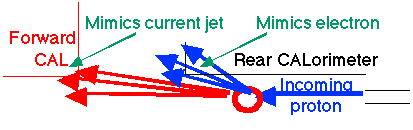 Figure
4. Topology of a typical upstream proton beam-gas interaction.
Figure
4. Topology of a typical upstream proton beam-gas interaction.
Proton beam-gas events that originate in the detector can be eliminated with cuts on (Etot - Pz tot) as described in section 2.1.1. The very small background remaining after these cuts and the very small background from electron beam-gas background is calculated from the event rate for special non-colliding bunches of electrons and protons that are not paired with a corresponding proton or electron bunch.
The Neutral Current ep DIS differential cross section is:
 ,
,
where Y± = 1 ± (1 - y2). The virtual photon is either longitudinally or transversely polarized. The structure function F2(x,Q2) gives the interaction between transversely polarized photons and spin-1/2 partons and equals the charge weighted sun of the quark distributions. The structure function FL(x,Q2) gives the cross section due to longitudinally polarized photons that interact with the proton. The partons that interact with these photons need to have high transverse momentum, which happens predominantly at high-y. The structure function F3(x,Q2) is the parity violating structure function which is due to Z0 exchange, which is only an appreciable part of the cross section at high Q2.
Beginning in 1967, a series of ep scattering experiments at SLAC showed that the DIS cross section fell weakly with increasing Q2 and that the momentum distributions of the proton constituents (i.e. the Structure Functions), depended only on x. The Q2 independence of the structure functions, called scaling, had been predicted by Bjorken and was incorporated by Feynman into the parton model, which assumed the proton was composed of non-interacting point-like partons, from which the electron scatters incoherently.
In the parton model, the structure function F2 is given by
the charge-weighted sum of the parton momentum densities,
 .
For spin-1/2 partons, FL = 0 and for spin-zero partons, FL
= F2. The parton densities are not calculable in this model
and therefore are derived from experiment. DIS provides an excellent laboratory
for the extraction of the parton densities because the electromagnetic
probe is well understood.
.
For spin-1/2 partons, FL = 0 and for spin-zero partons, FL
= F2. The parton densities are not calculable in this model
and therefore are derived from experiment. DIS provides an excellent laboratory
for the extraction of the parton densities because the electromagnetic
probe is well understood.
In the quark-parton model, partons are identified with fractionally charged quarks that come in several flavors. The proton is made of three valence quarks, and a distribution of quark-antiquark pairs called the sea quarks. The singlet and non-singlet quark flavor combinations are defined as:
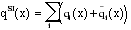 ,
, 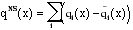 ,
,
where the subscript i runs over all flavors. Under the assumption
that u(x) = uv(x) + us(x) and  ,
we have
,
we have  where v and s stand
for valence and sea, respectively. The measurement of the momentum sum
rule,
where v and s stand
for valence and sea, respectively. The measurement of the momentum sum
rule, , and its experimental determination
to be roughly 0.5, led to acceptance of the addition of the electrically
neutral gluons, the field quanta responsible for the binding of the quarks,
to the proton constituents, i.e.
, and its experimental determination
to be roughly 0.5, led to acceptance of the addition of the electrically
neutral gluons, the field quanta responsible for the binding of the quarks,
to the proton constituents, i.e. 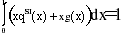 .
Therefore, measurement of the gluon momentum density, xg(x), is required
to fully understand the structure of the proton. It is also particularly
important at low x, where gluon scattering dominated the proton collision
cross sections.
.
Therefore, measurement of the gluon momentum density, xg(x), is required
to fully understand the structure of the proton. It is also particularly
important at low x, where gluon scattering dominated the proton collision
cross sections.
QCD produces interactions between quarks and gluons which cause the quarks to acquire transverse momentum, which causes scaling violation: F2(x) Æ F2(x,Q2). Examples of these interactions are shown in Figure 5 . The probabilities for these interactions, are called splitting functions, and have a ln(Q2) behavior.
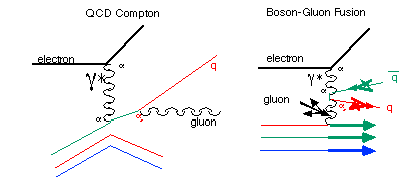
As Q2 increases, the photon is able to resolve finer structure in the proton and interacts with the cloud of partons (quarks and gluons) around each valence quark that share the proton's momentum. As x decreases, the fraction of proton momentum needed to be carried by the struck parton decreases, increasing the likelihood that such a parton is present. Therefore, we expect the number of quarks to increase with decreasing and we expect this effect to be more pronounced at higher Q2. The detailed expectations for these changes are discussed below.
The evolution of the quark and gluon densities of the proton with Q2
and x is given by perturbative QCD. Given an empirical parameterization
for the parton densities at some Q2 = Q02:
 ,
,  ,
and
,
and
 , the Dokshitzer-Gribov-Lipatov-Altarelli-Parisi
(DGLAP) equations describe the evolution of the parton densities to higher
Q2:
, the Dokshitzer-Gribov-Lipatov-Altarelli-Parisi
(DGLAP) equations describe the evolution of the parton densities to higher
Q2: 
 ,
,
where the functions Pij (x/y) are called the
splitting functions, which give the probability that a parton (either a
quark or a gluon) i with momentum fraction x originated from
a parton j with momentum fraction y, where x < y <
1. The coupling constant as of the
strong force is given in lowest order by: 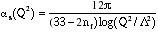 ,
where nf is the number of flavors and L
is a QCD parameter that governs the Q2 dependence and
in particular sets the boundary for Q2 » L2
where as is sufficiently small to
justify a perturbative treatment in terms of quasi-free quarks and gluons.
The logarithmic radiative QCD processes and their subsequent parton evolution
as characterized by the DGLAP equations result in the logarithmic scaling
violations that render the structure functions dependent on both x and
Q2. Even though the structure function F2 is given
by
,
where nf is the number of flavors and L
is a QCD parameter that governs the Q2 dependence and
in particular sets the boundary for Q2 » L2
where as is sufficiently small to
justify a perturbative treatment in terms of quasi-free quarks and gluons.
The logarithmic radiative QCD processes and their subsequent parton evolution
as characterized by the DGLAP equations result in the logarithmic scaling
violations that render the structure functions dependent on both x and
Q2. Even though the structure function F2 is given
by  , since the DGLAP equations
couple the quark and gluon distributions, F2 also depends on
the gluon distribution as well as the quark distributions. Moreover, since
the structure function is extracted from the cross section and the calculation
of the DIS cross section requires FL:
, since the DGLAP equations
couple the quark and gluon distributions, F2 also depends on
the gluon distribution as well as the quark distributions. Moreover, since
the structure function is extracted from the cross section and the calculation
of the DIS cross section requires FL:
 ,
,
the parameterization of the gluon density can be determined by fitting QCD evolution to the DIS data.
Parton Distribution Functions (PDF's) describe the sharing of the proton's momentum amongst its partons (gluons, valence and sea quarks. Martin, Roberts and Stirling (MRS) and the Coordinated Theoretical/Experimental Project on QCD (CTEQ) assume g(x,Q02) ~ xg1 and F2(x,Q02) ~ xg2, where Q02 = 4 GeV2 and then evolve in Q2 according to the DGLAP equations, using the a single parametrization to produce a global fit to the world DIS data. Gluck, Reya and Vogt (GRV) start with valence-like parton (gluon, valence and sea quark) distributions at Q02 = 0.3 GeV2 and then evolve in Q2 using the DGLAP equations. This dynamically generated growth in the parton distribution functions (PDF's) predicts a rapid rise at low-x with g(x,Q2) and F2(x,Q02) ~ xg , where g « -0.08.
In the low-Q2 region where the proton is mostly sea quarks and gluons, perturbative QCD cannot be used and other models must be used to predict the behavior of the structure functions. One approach is to use Regge theory, which describes hadron-hadron and real photoproduction cross sections in terms of the exchange of a non-perturbative particle, or "reggeon" in the t-channel. In the limit as s Æ , only one of these reggeons survives, the pomeron. The pomeron has the quantum numbers of the vacuum. Donnachie and Landshoff (DL) extended the Regge picture to virtual photoproduction cross sections for Q2 < 10 GeV2. This approach assumes that
 Therefore, they relate the
structure function to reggeon exchange phenomena which successfully describe
the slow rise of total cross sections with center of mass energy in hadron-hadron
and photoproduction reactions.
Therefore, they relate the
structure function to reggeon exchange phenomena which successfully describe
the slow rise of total cross sections with center of mass energy in hadron-hadron
and photoproduction reactions.
In the limit x Æ 0 the splitting functions become singular and the ln(1/x) terms become important. The Balitsky, Fadin, Kuraev and Lipatov (BFKL) equation is a perturbative QCD approach that resums the leading powers of ln(1/x), producing an evolution equation in x. The analytic solution to this equation results in a gluon distribution:

The BFKL approach may be viewed as the exchange of many gluons, which corresponds to the same quantum numbers as the pomeron. This multigluon system is referred to as the BFKL pomeron. Since this perturbative QCD process is taking place at relatively high t, the BFKL pomeron is called a "hard pomeron" in contrast to the "soft pomeron" referred to above in the non-perturbative DL model, which is exchanged at low t.
The measurement of F2 at HERA starts by binning the data in x and Q2 and subtracting the background. The cross section is multiplied by a QCD calculation of FL using parameterizations of q(x,Q2) and g(x,Q2). The acceptance is measured by a Monte Carlo calculation. F2 is then unfolded iteratively until the Monte Carlo matches the data. Finally, the systematic errors are estimated by repetition of the analysis with excursions within the error envelope.
The H1 and ZEUS F2 data cover a large kinematic range with Q2 from 0.16 to 15,000 GeV2 and x values between 3 x 10⁻⁶ and 0.8. The experiments have been able to explore the low-x, low-Q2 regime through several techniques. Both H1 and ZEUS have taken shifted vertex (SVX) runs with the interaction point moved in the proton direction to give an extended lever arm for electrons striking their rear calorimeters, thereby reducing the acceptance cutoff for low Q2. In addition, both experiments analyzed data with initial state radiation (ISR) from the electron, which reduced the energy of the incoming electron, which also permits access to lower Q2 scattering within the detector acceptance. Finally, ZEUS added a calorimeter behind and between the rear calorimeter and the beampipe. This beampipe calorimeter (BPC) detects electrons scattering at very shallow angles that would otherwise be unobserved.
Figure 6 compares the range of structure function measurements from H1 and ZEUS with deep inelastic fixed target electron scattering at SLAC and muon scattering at CERN (BCDMS, NMC) and Fermilab (E665). This shows that the HERA experiments have extended the range of both x and Q2 measurements by more than two orders of magnitude. There is also considerable overlap between the HERA results and those of E665 and NMC, providing for comparisons with the fixed target regime.
Figure 7 shows the final results for F2 versus x in Q2 bins from the H1 and ZEUS 1994 data sets, along with the fixed target muon scattering experiments BCDMS, NMC and E665. The dramatic rise in F2 with decreasing x is evident over a wide Q2 range from 1.5 to 5000 GeV2. This rise is attributed to a sharp increase in the gluon content with decreasing x at low values of x. This singular gluon behavior is further discussed in section 2.3.3.
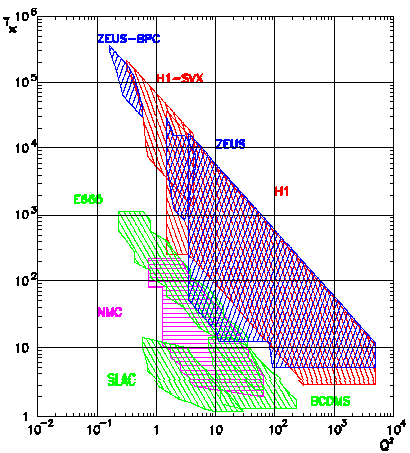 Figure
6. Kinematic Range of structure function measurements.
Figure
6. Kinematic Range of structure function measurements.
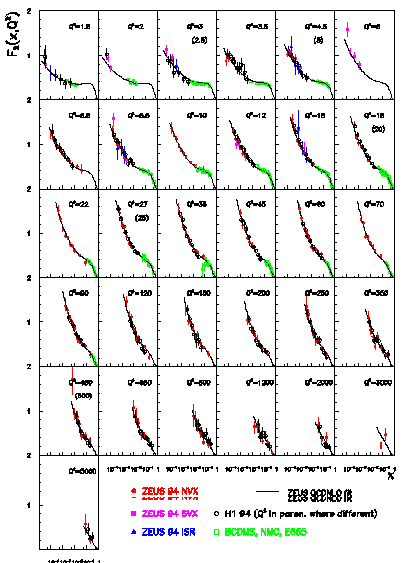 Figure
7. Measurements of F2 versus x for various Q2 bins
from H1, ZEUS (Normal VerteX, Shifted VerteX, and Initial State Radiation
samples) and fixed target muon scattering experiments at CERN (NMC, BCDMS)
and Fermilab (E665).
Figure
7. Measurements of F2 versus x for various Q2 bins
from H1, ZEUS (Normal VerteX, Shifted VerteX, and Initial State Radiation
samples) and fixed target muon scattering experiments at CERN (NMC, BCDMS)
and Fermilab (E665).
There is good agreement between H1 and ZEUS, as well as between the HERA results and the fixed target muon scattering data of BCDMS, NMC and E665. Also shown is a next-to-leading order (NLO) QCD fit used for the acceptance calculation for ZEUS. This fit agrees well with the data, showing that the QCD evolution characterized by the DGLAP equations describes that data well down to x = 3 x 10⁻⁵ . The agreement between the data and the ZEUS QCD NLO fit indicates that the DGLAP evolution approaches of MRS, CTEQ and GRV are sufficient to explain the data shown in Figure 7 and that it is not necessary to invoke the BFKL equation to resum the ln(1/x) terms in the kinematic regime covered by the HERA data thus far. Further investigation at low x and low Q2 is discussed in section 2.3.4.
At large x and at Q2 values up to 70 GeV2, where the HERA data reach the x-range covered by the fixed target experiments, good agreement with the muon scattering results is observed. The agreement of the QCD NLO fit with both the HERA and fixed target muon scattering data shows a consistent picture between QCD evolution and the experiments over a wide kinematic range. This observation is further underscored by the good agreement between the HERA data and the latest parton distribution functions from the global data analyses produced by CTEQ and MRS.
Figure 8 shows measurements of F2 as a function of Q2 for various bins of x from H1, ZEUS and fixed target muon scattering experiments at CERN (NMC, BCDMS) and Fermilab (E665). There is good agreement between ZEUS and H1, as well as good agreement between the HERA measurements and the fixed target results where they overlap from x = 0.004 through 0.081. The QCD NLO fit is also shown. It agrees well with the HERA and muon scattering data, indicating that the measured x-Q2 behavior of F2 is described by QCD using DGLAP evolution over the full kinematic range. The plot also shows the variation of F2 with Q2, showing strong QCD-predicted scaling violations for x < 0.02. Since these scaling violations are caused by gluon radiation, they can be used to determine the gluon distribution.
As pointed out in section 2.2.3, the logarithmic slope dF2/dlnQ2 provides a measurement of the gluon distribution. An example of the fitting technique can be taken from the ZEUS analysis of the 1994 F2 data. The NMC data was used to constrain the fit at larger values of x. The momentum sum rule was used to constrain the gluon
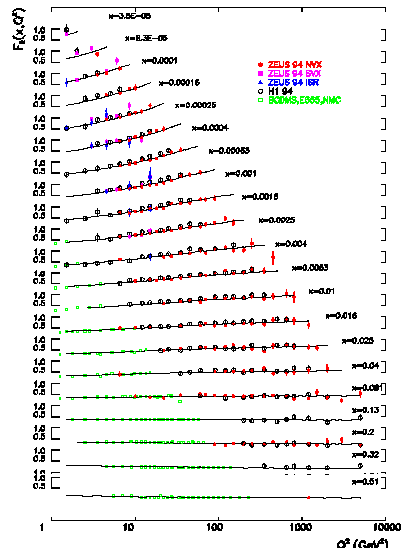 Figure 8. F2
versus Q2 for various bins of x for H1, ZEUS, and for
fixed target muon scattering (BCDMS, E665, NMC) along with the NLO QCD
fit to ZEUS data.
Figure 8. F2
versus Q2 for various bins of x for H1, ZEUS, and for
fixed target muon scattering (BCDMS, E665, NMC) along with the NLO QCD
fit to ZEUS data.
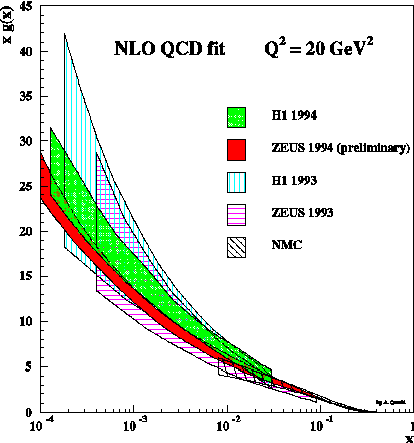 Figure 9. Results
for fits to the gluon distribution from H1 and ZEUS from the 1993 and 1994
data sets.
Figure 9. Results
for fits to the gluon distribution from H1 and ZEUS from the 1993 and 1994
data sets.
density. The functional forms of the quark and gluon densities shown in section 2.2.3 were assumed. The SLAC/BCDMS value of as(MZ2) = 0.113 was assumed and evolved to higher Q2. The quark and gluon distributions were evolved using the DGLAP equations to measured Q2 bins to calculate F2 and this was compared to the data by computing a c2 with statistical errors only. A nonlinear minimization of the c2 was then used to find the fit parameters of the assumed functional forms of the quark and gluon distributions. Finally, the systematic uncertainty was estimated separately by varying each of the 31 different systematic effects individually and performing a new fit.
Figure 9 shows the results of NLO QCD fits for the gluon density from H1, ZEUS and NMC16 data for Q2 = 20 GeV2. The most striking effect is the more than an order of magnitude increase in the gluon content of the proton from about one gluon per unit of rapidity to more than 20 for x approaching 10-4. It is also important to notice the major increase in range from that of the NMC experiment to the HERA results, as well as the significant improvement in the uncertainty and validity range in the kinematic plane between the 1993 and 1994 HERA measurements, while the agreement between the 1993 and 1994 HERA measurements remains quite good.
The ZEUS measurement found an exponent of the gluon distribution (see section 2.2.3) dg = 0.24 ± 0.02 and the momentum sun rule at Q2 = 7 GeV2 determined contributions of 0.555 quarks + 0.445 gluons.
There are some general caveats in order concerning the extraction of F2 and the gluon density. These analyses involve a priori assumptions for as and the quark-gluon parameterization in order to compute the FL and F3 corrections to the DIS cross section. The extracted F2 is sensitive to these assumptions, particularly for the high-y kinematic range data, which is sensitive to the gluon. Therefore, it is more prudent to perform an assumption independent analysis by directly fitting the cross section data. The results of such an analysis can yield consistent values for as and the quark and gluon parameterizations.
The use of techniques as shifted vertex running and initial state radiation
analysis, as well as the data from the ZEUS beampipe calorimeter (BPC)
have enabled measurements at lower Q2 in the low-x region. This
allows the study of the transition between DIS and photoproduction. At
Q2 = 0, the dominant processes are non-perturbative and described
by Regge theory. As Q2 increases, it is expected to observe
the onset of perturbative QCD. The nature of the transition from a soft
process of low virtuality to a hard process of high virtuality should provide
understanding of both types of interactions. Knowledge of the low x and
low Q2 region is also needed for the calculation of radiative
corrections. 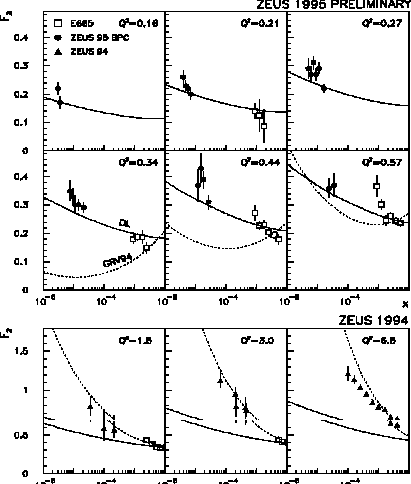 Figure 10. F2
versus x in Q2 bins from the 1995 ZEUS BPC (upper 6 plots)
and 1994 shifted and normal vertex (lower 3 plots) data shown with E665
muon scattering results at the closest Q2 values. Also shown
are the theoretical predictions of GRV (dotted lines) and DL (solid lines).
Figure 10. F2
versus x in Q2 bins from the 1995 ZEUS BPC (upper 6 plots)
and 1994 shifted and normal vertex (lower 3 plots) data shown with E665
muon scattering results at the closest Q2 values. Also shown
are the theoretical predictions of GRV (dotted lines) and DL (solid lines).
The top six plots of Figure 10 show the preliminary ZEUS BPC F2 results for 0.16 2 Q2 2 0.57 GeV2. Also shown are the data from the E66517 measurement at a similar Q2, but much larger x. There is a rise in F2 of approximately 1.5 to 2 from x near 10-3 to x near 10-5. The bottom of Figure 10 shows F2 values from ZEUS and E665 for Q2 = 1.5, 3.0 and 6.5 GeV2 showing a rapid rise of F2 as Q2 increases. The rise of F2 over 2 to 3 decades in x from E665 to ZEUS for 0.16 2 Q2 2 0.57 GeV2 agrees with the expectations of the DL model discussed in Section 2.2.5. However, at higher Q2, the DL prediction falls substantially below the ZEUS result. The GRV perturbative QCD prediction for F2 accounts for about 40% of the measured F2 at Q2 = 0.44 GeV2 and about 80% at Q2 = 0.57 GeV2. At larger Q2 values the GRV prediction reproduces the rapid rise of F2, but is somewhat higher. We therefore observe the transition from a region of Q2 2 0.5 GeV2, where the DL soft pomeron model describes almost real photoproduction and the perturbative QCD picture does not describe the measured behavior, to a region of Q2 3 1.5 GeV2, where a perturbative QCD prediction is valid and the Regge picture is no longer appropriate.
A useful way to display the results for F2 is to plot the
total g*p cross section using the relation:
 . Figure 11 shows s(g*p)
as measured by ZEUS21,22 and E66517 as a function of W2 for
Q2 bins from 0.15 through 6.5 GeV2. The total real
photon-proton cross section measurements from ZEUS,
H1 and fixed target experiments are also shown. The curves show the DL
soft pomeron model and the GRV perturbative QCD model. As discussed in
section 2.2.5, the DL model predicts s(g*p)
~ (W2)0.08. The GRV model predicts a stronger variation
with Q2 and W2. At low Q2, the DL model
describes the data well, but fails at Q2 3 1.5 GeV2.
At Q2 3 1.5 GeV2, the GRV prediction agrees with
the rapid rise in s(g*p) with W2
observed in the data.
. Figure 11 shows s(g*p)
as measured by ZEUS21,22 and E66517 as a function of W2 for
Q2 bins from 0.15 through 6.5 GeV2. The total real
photon-proton cross section measurements from ZEUS,
H1 and fixed target experiments are also shown. The curves show the DL
soft pomeron model and the GRV perturbative QCD model. As discussed in
section 2.2.5, the DL model predicts s(g*p)
~ (W2)0.08. The GRV model predicts a stronger variation
with Q2 and W2. At low Q2, the DL model
describes the data well, but fails at Q2 3 1.5 GeV2.
At Q2 3 1.5 GeV2, the GRV prediction agrees with
the rapid rise in s(g*p) with W2
observed in the data.
Figure 12 explores the dependence of the exponent
l in  as a function of
Q2 from the H1 F2 data.
There is a steady decrease in l with decreasing
Q2. The data show a smooth transition from the higher to lower
Q2 regions in the Q2 range covered by the H1 data
from 0.35 to 3.5 GeV2 down to 6 x 10⁻⁶. The H1 experiment
also reports25 that the distinct rise in F2 with decreasing
x that is observed for Q2 > 2 GeV2 is sharply
reduced with decreasing Q2 until the rise observed at small
Q2 is close to that expected by Regge models.
as a function of
Q2 from the H1 F2 data.
There is a steady decrease in l with decreasing
Q2. The data show a smooth transition from the higher to lower
Q2 regions in the Q2 range covered by the H1 data
from 0.35 to 3.5 GeV2 down to 6 x 10⁻⁶. The H1 experiment
also reports25 that the distinct rise in F2 with decreasing
x that is observed for Q2 > 2 GeV2 is sharply
reduced with decreasing Q2 until the rise observed at small
Q2 is close to that expected by Regge models.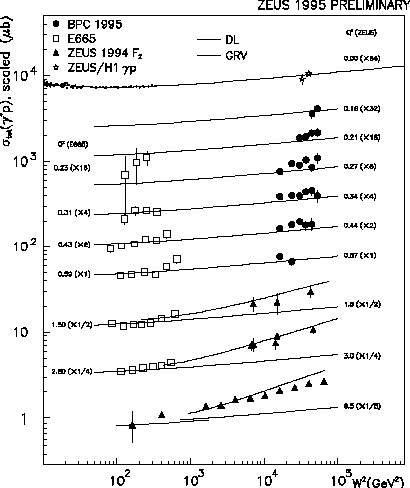 Figure
11. Total g*p cross section,
Figure
11. Total g*p cross section, 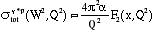 as a function of W2 for ZEUS and E665. The total cross section
for real photon proton scattering from ZEUS, H1 and fixed target experiments
at low W are also shown.
as a function of W2 for ZEUS and E665. The total cross section
for real photon proton scattering from ZEUS, H1 and fixed target experiments
at low W are also shown.
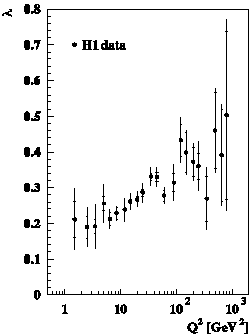 Figure 12. Dependence
of l in
Figure 12. Dependence
of l in  on Q2 from H1.
Figure 13 shows s(g*p) as a function of Q2
with the cross sections at different W values indicated by different
symbols. The data between Q2 = 0.16 and 0.57 GeV2
show the same decrease with increasing Q2 for all values of
W between 130 GeV and 230 GeV. This is consistent with the Regge picture
as shown by the agreement with the DL model. For Q2 3 1.5 GeV2,
we again observe behavior consistent with a perturbative QCD picture as
shown by the agreement with the GRV model.
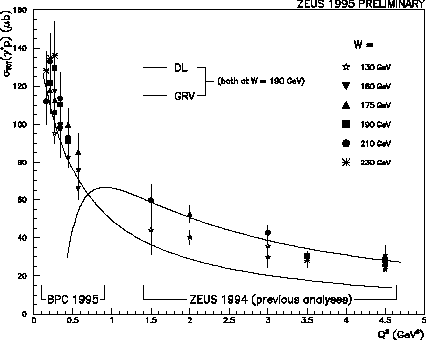 Figure 13. The total virtual
photon-proton cross section stot (g*p)
as a function of Q2 from ZEUS 1995 BPC and 1994 SVX and NVX
data for various mean W2 values. Also shown are the predictions
of GRV (upper curve for Q2 > 1.5) and DL.
Figure 13. The total virtual
photon-proton cross section stot (g*p)
as a function of Q2 from ZEUS 1995 BPC and 1994 SVX and NVX
data for various mean W2 values. Also shown are the predictions
of GRV (upper curve for Q2 > 1.5) and DL.
Therefore, we see that the rapid rise in F2 with decreasing
x observed by H1 and ZEUS for Q2 3 1.5 GeV2
and x « 10-2 changes to a moderate rise in the
low Q2 region. This indicates a transition from the high-Q2
perturbative QCD region to the low Q2 region where Regge
models provide a good description, while perturbative QCD does not. We
also see that the transition region between these two regimes is smooth
with an interplay between the two in the intermediate Q2 range.
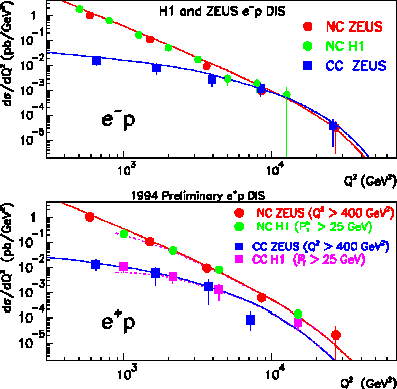
At high Q2 (> 200 GeV2), The charged current
and neutral current cross sections reported by H1 and ZEUS have established
that the Q2 dependence of the CC and NC cross sections are consistent
with the W and Z propagators and that the CC and NC cross sections have
a similar magnitude for Q2 3 MW2. ZEUS
has shown that the NC DIS cross section ds/dQ2,
for e+p and e-p collisions at 200 <
Q2 < 50,000 GeV2 shows good agreement with the
standard model and uses this to set limits of 1.0 to 2.5 TeV at 95% CL
on the effective mass of contact interactions and to place a limit of 1.4
x 10-16 cm at 95% CL on the effective quark radius. H1 have
measured the integrated CC cross section and the differential cross section
for e+p collisions with missing transverse momentum above
25 GeV. These results are summarized in Figure 14. Both H1 and ZEUS have
used these cross sections to extract the W mass:  in good agreement with the 80.22 ± 0.26 GeV on-shell W mass measured
at the Tevatron.
in good agreement with the 80.22 ± 0.26 GeV on-shell W mass measured
at the Tevatron.
 Figure
14. CC and NC DIS cross sections at high Q2 from H1 and ZEUS for e-p
and e+p collisions, compared with Standard Model predictions.
Figure
14. CC and NC DIS cross sections at high Q2 from H1 and ZEUS for e-p
and e+p collisions, compared with Standard Model predictions.
In the naive quark-parton model, DIS virtual photoproduction gives rise to one jet from the struck quark and one jet from the proton remnant, which at HERA escapes undetected down the beampipe. We denote such events as 1+1, where the +1 refers to the unseen remnant jet. The production of additional jets in DIS beyond 1+1 involves QCD since it is due to the involvement of gluons in the hard scattering process. In particular, dijet or 2+1 jet production, to leading order in as , proceeds via QCD-Compton scattering (QCDC) characterized by the emission of a gluon from the struck quark and Boson-Gluon-Fusion, where a gluon from the proton and the virtual boson fuse to form a quark-antiquark pair. The basic DIS parton emission processes up to leading order in as are shown in Figure 15. Shown are (a) the Born process where a single quark is emitted, (b) BGF, (c) QCDC where the gluon is emitted in the final state and (d) in the initial state, and (e) gluon emission in the final and initial state as viewed in the Breit Frame. In the naive quark parton model, the Breit Frame is the frame where the struck quark is scattered exactly backwards to its original direction and has no transverse momentum component. However, QCD processes introduce a net transverse momentum component to the incoming parton or the struck quark itself.
The strong coupling constant, as,
can be measured at HERA from the relative rate of 2+1 jet events to 1+1
jet events. This measurement can be performed for different values of Q2
so that it is possible to see the evolution of as
within a single experiment over a wide range of Q2. For
the extraction of as to be reliable,
the 2+1 jet rate must be calculated to NLO and the jet definition must
be treated in the same way for experiment and theory.
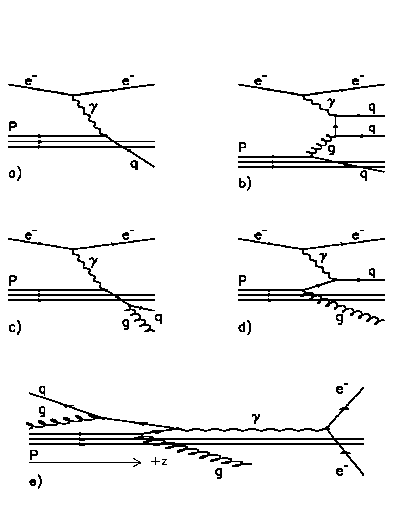 Figure
15. DIS parton emission processes to leading order in as:
a) Born process, b) Boson Gluon Fusion, c)
final state gluon radiation, d) initial state gluon radiation, e) Breit
Frame view of initial and final state gluon radiation.
Figure
15. DIS parton emission processes to leading order in as:
a) Born process, b) Boson Gluon Fusion, c)
final state gluon radiation, d) initial state gluon radiation, e) Breit
Frame view of initial and final state gluon radiation.
Both H1 and ZEUS have extracted as from multi-jet production. They used the JADE algorithm to assemble the jets and relate the hadronic final state measured in the detector to the hard scattering process. The algorithm employs a scaled invariant mass yij = mij2/W2 = 2EiEj(1-cosqij)/W2, where mij is the invariant mass of objects i and j, which are assumed massless and Ei, Ej are their energies. Objects are merged into jets by adding their four-momenta until yij for all objects exceeded a jet resolution parameter ycut. To prevent the detected fraction of the proton remnant jet from forming spurious jets, a pseudo-particle was inserted along the z-axis (proton direction) and the missing longitudinal momentum in each event was assigned to it. Both H1 and ZEUS extracted values of as at ycut = 0.02. Even this value of ycut, which requires a large invariant mass between the jets, does not constrain the jets to be away from the beam direction. This is because one of the non-remnant 2+1 jets is often in the forward direction due to the forward singularity in the cross section. This forward direction has he greatest model uncertainty. Therefore H1 impose a cut in the jet polar angle in the laboratory system (qjet > 10º). They also impose a cut in the backwards direction (qjet < 145º) to ensure analysis in the hadronic calorimeter. In contrast, ZEUS uses a cut on z= 1/2(1-cosq*), where q* is the angle of the parton the produced the jet in the g*-parton center of mass system, of 0.1 < z < 0.9. The variable z is a Lorentz invariant and a well-defined variable in the theory. These cuts on the jet position significantly reduce the statistics. In the case of the ZEUS cut, the loss is 50%.
Figure 16 shows the corrected jet rates R1+1, R2+1 and R3+1 as a function of ycut for ZEUS data31 compared with the DISJET and PROJET NLO QCD calculations for three Q2 intervals between 120 and 3600 GeV2 and the whole range. Both programs agree in their predictions for as and reproduce the shape of the measured jet rate distributions. H1 performed a similar analysis for two Q2 intervals, 100 - 400 and 400 - 4000 GeV2.
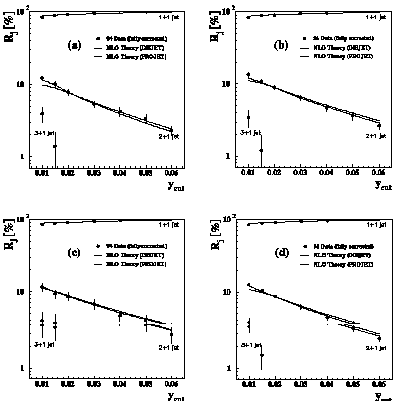 Figure
16. ZEUS results for jet production rates, Rj as a function
of the jet resolution parameter ycut for a) 120 <
Q2 < 240 GeV2, b) 240 < Q2 <
720 GeV2, c) 720 < Q2 < 3600 GeV2
and d) 120 < Q2 < 3600 GeV2 with statistical
errors only compared with 2 NLO QCD calculations, DISJET and PROJET.
Figure
16. ZEUS results for jet production rates, Rj as a function
of the jet resolution parameter ycut for a) 120 <
Q2 < 240 GeV2, b) 240 < Q2 <
720 GeV2, c) 720 < Q2 < 3600 GeV2
and d) 120 < Q2 < 3600 GeV2 with statistical
errors only compared with 2 NLO QCD calculations, DISJET and PROJET.
The running of as depends on the
renormalization group equation. The extraction of as
in finite order QCD perturbative calculations depends on the renormalization
scheme. H1 and ZEUS use the  scheme. In second order, the dependence on other renormalization schemes
is characterized by a single parameter, the value of the renormalization
scale where as is evaluated. H1 and
ZEUS chose this to be Q2. The same scale, Q2, is
chosen for the factorization scale where the parton densities are evaluated.
scheme. In second order, the dependence on other renormalization schemes
is characterized by a single parameter, the value of the renormalization
scale where as is evaluated. H1 and
ZEUS chose this to be Q2. The same scale, Q2, is
chosen for the factorization scale where the parton densities are evaluated.
The ZEUS values31 of as extracted
using the JADE cluster algorithm are plotted in Figure 17 as a function
of Q2 for 3 Q2 ranges. They are calculated from the
fitted values of  and plotted
against the curves for
and plotted
against the curves for  = 100,
200 and 300 MeV. ZEUS uses 5 flavors in the calculation of L
because the lower bound of the Q2 range is above the
b-quark mass threshold. The measured as
decreases with increasing Q2 as expected from the running
of the strong coupling constant if Q2 is taken as the scale.
Extrapolating these measurements to Q = MZº yields the
ZEUS result from the JADE algorithm that as(MZº)
= 0.117 ± 0.005 (stat)
= 100,
200 and 300 MeV. ZEUS uses 5 flavors in the calculation of L
because the lower bound of the Q2 range is above the
b-quark mass threshold. The measured as
decreases with increasing Q2 as expected from the running
of the strong coupling constant if Q2 is taken as the scale.
Extrapolating these measurements to Q = MZº yields the
ZEUS result from the JADE algorithm that as(MZº)
= 0.117 ± 0.005 (stat)  (systexp) ± 0.007 (systtheory).
H1 also extract their result30 using the JADE algorithm, but with 4 flavors
in the calculation of L and determine as(MZº)
= 0.123 ± 0.018, with statisticsl and systematic errors combined
in quadrature. The difference in number of flavors should be a small effect
since the contribution to the proton structure function from massive b-quarks
in the kinematic region studied in these measurements is less than 2%.
The H1 and ZEUS values of as are
in agreement with the world average result28 of as(MZº)
= 0.117 ± 0.005. This constitutes an important test of QCD.
(systexp) ± 0.007 (systtheory).
H1 also extract their result30 using the JADE algorithm, but with 4 flavors
in the calculation of L and determine as(MZº)
= 0.123 ± 0.018, with statisticsl and systematic errors combined
in quadrature. The difference in number of flavors should be a small effect
since the contribution to the proton structure function from massive b-quarks
in the kinematic region studied in these measurements is less than 2%.
The H1 and ZEUS values of as are
in agreement with the world average result28 of as(MZº)
= 0.117 ± 0.005. This constitutes an important test of QCD.
The ZEUS experiment also explored the dependence of the as
measurement on use of another cluster algorithm, the kt algorithm,
which is evaluated in the Breit frame and uses a jet resolution parameter
based on the minimum transverse energy of one particle relative to the
other, yij = 2min(Ei2,Ej2)(1-cosqij)/Mref2,
where Mref2 is either Q2 or a fixed value
of 120 GeV2 . A second parameter, the
transverse energy of the particle relative to the incoming proton direction,
yip =2Ei2(1-cosqip)/Q2,
is used to distinguish particles that belong to the proton remnant jet
from those which form jets by the condition yip <
yij for inclusion in the remnant jet. The kt
algorithm does not require a z cut with its loss of statistics nor a pseudo-particle
to take care of the remnant jet. Its detector and hadronization corrections
are smaller than those of the JADE algorithm. Finally, due to the definition
of the energy-angle correlation of the particles with respect to the proton
direction, initial state collinear singularities can be dealt with in a
well-understood manner29. Figure 17 shows the extracted ZEUS values38 of
as extracted using the kt
cluster algorithm as a function of Q2 for 3 Q2 ranges with , Mref2
is either equal to Q2 or a fixed value of 120 GeV2. Extrapolating these
measurements to Q = MZº yields the ZEUS results from the
kt algorithm that as(MZº)
= 0.118 ± 0.008 (stat) for Mref2 = Q2 and 0.120
± 0.004 (stat) for Mref2 = 120 GeV2. These values
are close to the value of 0.117 extracted using the JADE algorithm indicating
only a small dependence on the choice between the JADE and kt
cluster algorithms.
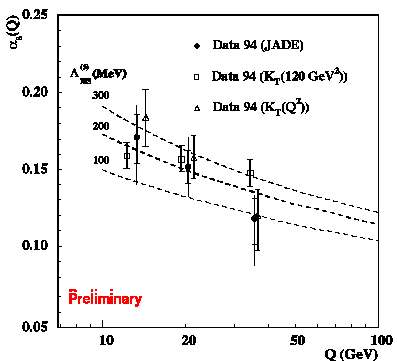 Figure
17. ZEUS measured values of as(Q)
for three different Q2 regions, extracted using three different
jet algorithms. The statistical error corresponds to the inner bar and
the thin bar shows the statistical and systematic error combined in quadrature.
The dashed curves represent as with
Figure
17. ZEUS measured values of as(Q)
for three different Q2 regions, extracted using three different
jet algorithms. The statistical error corresponds to the inner bar and
the thin bar shows the statistical and systematic error combined in quadrature.
The dashed curves represent as with
 = 100, 200 and 300 MeV.
For low Q2 ep scattering, the photon is essentially real
and the involvement of the electron can be essentially neglected. Such
events are therefore called photoproduction events. Since the cross section
has a 1/Q4 dependence, these events are the most common type
of ep interaction. Although the center of mass of the ep collisions is
300 GeV at HERA, the center of mass energy of the photon-proton collisions,
Wgp=  ,
has a range from less than 130 GeV to more than 270 GeV. This is equivalent
to a beam of 20 TeV photons striking a fixed proton target. These energies
are sufficiently high to permit a photon that has fluctuated into a quark-antiquark
pair to travel as a hadronic particle for hundreds of proton radii without
violating the Heisenberg Uncertainty Principle.
,
has a range from less than 130 GeV to more than 270 GeV. This is equivalent
to a beam of 20 TeV photons striking a fixed proton target. These energies
are sufficiently high to permit a photon that has fluctuated into a quark-antiquark
pair to travel as a hadronic particle for hundreds of proton radii without
violating the Heisenberg Uncertainty Principle.
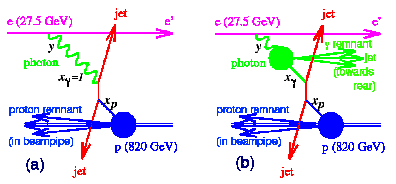 Figure
18. Topology of (a) Direct Photoproduction and (b) Resolved Photoproduction.
Figure
18. Topology of (a) Direct Photoproduction and (b) Resolved Photoproduction.
Photoproduction events are classified into direct and resolved categories. The topology of a direct photoproduction event is shown in Figure 18a. Direct photoproduction occurs when the photon interacts directly with a quark or gluon in the proton. In this case, the fraction of the photon momentum involved in the collision, xg, is close to one. Due to the low Q2 the scattered electron emerges at a very low angle and travels undetected down the beampipe in the original electron direction.. The hard scattering of the photon with a parton in the proton, carrying fraction of proton momentum, xp, can result in two outgoing partons with high Et, that manifest themselves as two jets in the main detector. The remaining particles from the proton, which form the proton remnant jet, travel down the beampipe in the proton direction. Figure 19 shows a high-Et direct photoproduction dijet event as observed in the ZEUS detector.
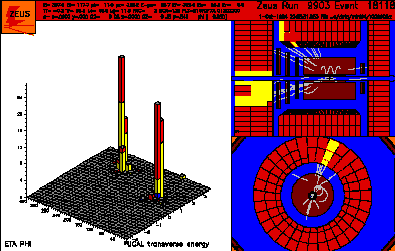 Figure
19. Direct photoproduction dijet event as seen in ZEUS.
Figure
19. Direct photoproduction dijet event as seen in ZEUS.
Figure 18b shows the topology of a resolved photoproduction event. Here
the scattered electron is also emitted at a very shallow angle. However,
the high energy photon fluctuates into a quark-antiquark pair, thereby
resolving into a hadronic state before the collision. Hence, the photon
acts like a source of quarks and gluons, one of which interacts with a
parton from the proton. Therefore, only a fraction of the photon's momentum,
xg, participates in the hard scatter,
i.e. xg < 1. The remaining photon
momentum is carried away by the other partons in the photon, which tend
to travel close to the original photon direction, which is close to the
scattered electron direction. The fragmentation of these remaining partons
from the photon is called the photon remnant and is found toward the rear
of the detector. As for the case of direct photoproduction, the fragmentation
of the remaining partons in the proton form the proton remnant, which travels
down the beampipe in the proton direction. Figure 20 shows a resolved photoproduction
event from ZEUS with two high-Et dijets and a photon remnant
observable in the rear of the detector.
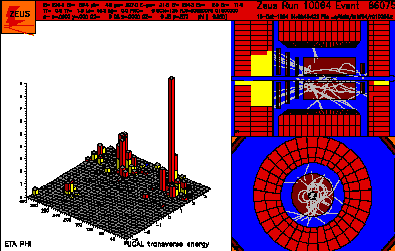 Figure
20. Resolved photoproduction High-Et dijet event as seen in
ZEUS. Note the presence of the photon remnant in the rear of the detector.
Figure
20. Resolved photoproduction High-Et dijet event as seen in
ZEUS. Note the presence of the photon remnant in the rear of the detector.
In Leading Order (LO) QCD, for direct photoproduction (Figure 21a) the photon interacts via boson-gluon fusion or QCD Compton scattering. These processes have a quark propagator in the s, t, or u channel, with the t and u channels dominating. For resolved photoproduction (Figure 21b) the dominant subprocesses (e.g. qg Æ qg, gg Æ gg, qq Æ gg) involve the t-channel exchange of a gluon. Since the Q2 of the photon is generally below 1 GeV, perturbative QCD cannot be used to describe the fluctuation of the photon into a hadronic state. Therefore, the photon is treated as a strongly interacting particle and a parton distribution function (PDF) is used to describe its structure. This model is called vector-meson dominance (VMD) since the photon must fluctuate into a meson with the same spin 1. Photon-PDF's are used to parameterize the probability to find a parton in the photon that carries a fraction of the photon's momentum, xg. The circles in the diagrams in Figure 21 indicate the PDF's for the photon and proton.
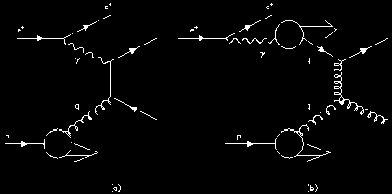 Figure
21. Examples of LO QCD diagrams for (a) direct photoproduction and (b)
resolved photoproduction.
Figure
21. Examples of LO QCD diagrams for (a) direct photoproduction and (b)
resolved photoproduction.
At Next-to-Leading-Order (NLO) in QCD the distinction between direct and resolved photoproduction blurs. Therefore, a separation of resolved and direct photoproduction was developed, based on the variable
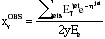 ,
,
where the sum runs over the two highest ET jets, hjet
= -ln(tanq/2)) is the pseudorapidity of the
jet, where q is the angle of the jet axis, and
y = Eg/Ee is the fraction
of the initial electron energy carried by the photon.  is the fraction of the photon's energy participating in the production
of the two highest ET jets. This variable is calculable to all
orders in perturbative QCD and is measurable. However, an additional complication
to the measurement of the jet energy is the contribution to the underlying
event energy from the spectator partons that produce the proton remnant
jet. Such multiparton interactions in beam remnants
have been used to describe hadron collider data. Since the dynamics of
hadronic final state interactions in hadronic collisions should resemble
those found in high energy photoproduction in ep collisions, these models
have been applied to HERA data,
is the fraction of the photon's energy participating in the production
of the two highest ET jets. This variable is calculable to all
orders in perturbative QCD and is measurable. However, an additional complication
to the measurement of the jet energy is the contribution to the underlying
event energy from the spectator partons that produce the proton remnant
jet. Such multiparton interactions in beam remnants
have been used to describe hadron collider data. Since the dynamics of
hadronic final state interactions in hadronic collisions should resemble
those found in high energy photoproduction in ep collisions, these models
have been applied to HERA data,
Figure 22 shows the  distribution
for ZEUS data using the kT jet clustering algorithm described
in section 2.5. The peak at high
distribution
for ZEUS data using the kT jet clustering algorithm described
in section 2.5. The peak at high  is from direct photoproduction, while resolved photoproduction extends
the tail down to low
is from direct photoproduction, while resolved photoproduction extends
the tail down to low  , where
the forward rapidity acceptance for jets cuts off. Events from the HERWIG
5.8 Monte Carlo are shown with and without
multiparton interactions45, . The Monte Carlo is normalized
to agree with the data for
, where
the forward rapidity acceptance for jets cuts off. Events from the HERWIG
5.8 Monte Carlo are shown with and without
multiparton interactions45, . The Monte Carlo is normalized
to agree with the data for  >
0.3. Irrespective of the multiparton interactions, both Monte Carlo histograms
do not match the data for
>
0.3. Irrespective of the multiparton interactions, both Monte Carlo histograms
do not match the data for  <
0.3, although the inclusion of multiparton interactions moves the histogram
closer. For
<
0.3, although the inclusion of multiparton interactions moves the histogram
closer. For  > 0.3, the HERWIG
Monte Carlo with multiparton interactions provides a good description of
the data. Therefore, ZEUS measures resolved photoproduction for
> 0.3, the HERWIG
Monte Carlo with multiparton interactions provides a good description of
the data. Therefore, ZEUS measures resolved photoproduction for  > 0.3. Also shown as the dark histogram is the HERWIG LO direct contribution,
with a vertical line drawn at
> 0.3. Also shown as the dark histogram is the HERWIG LO direct contribution,
with a vertical line drawn at  = 0.75 to define the region above this cut that corresponds to the LO definition
of direct photoproduction. Therefore, for data and calculations, we define
resolved and direct photoproduction by this cut in
= 0.75 to define the region above this cut that corresponds to the LO definition
of direct photoproduction. Therefore, for data and calculations, we define
resolved and direct photoproduction by this cut in  .
.
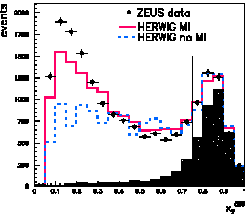 Figure
22.
Figure
22.  of ZEUS data without acceptance
correction (block dots) compared to HERWIG Monte Carlo with and without
multiparton interactions including all acceptance effects. The shaded histogram
is the subset of LO direct HERWIG events.
of ZEUS data without acceptance
correction (block dots) compared to HERWIG Monte Carlo with and without
multiparton interactions including all acceptance effects. The shaded histogram
is the subset of LO direct HERWIG events.
The photoproduction jet cross section as a function of transverse energy, ds/dETjet , falls steeply with ET, as predicted by QCD. The measured cross section is described by matrix elements summed according to the quark and gluon distributions of the quark and gluon distributions in the proton and photon, and is relatively less sensitive to these distributions than the features of the matrix elements. The photoproduction jet cross section as a function of the pseudo-rapidity, ds/dhjet, is sensitive to the parton distributions in the photon and can be used to extract them.
Figure 23 shows the inclusive differential jet photoproduction cross
sections, ds/dETjet and
ds/dhjet,
from H1. The H1 data is plotted using the pseudo-rapidity
in the lab frame, where h(lab) - h(cms)
= 0.5 ln(Ep/Eg) Å
2. Figure 23a shows the ET spectrum measured in two jet pseudo-rapidity
intervals, -1 < hjet < 1 and
-1 < hjet < 2. Figure 23b shows
the jet cross section as a function of hjet
for three different jet ET thresholds: Etjet
> 7, 11, and 15 GeV. The cross section decreases as (ETjet)-n
with n = 6.1 ± 0.5 between 7 < Etjet <
29 GeV for and -1 < hjet <
2. The ZEUS experiment also reports similar results and has extended these
measurements to higher ET and compared them with NLO QCD calculations.
The H1 and ZEUS results are consistent with the jet cross sections measured
in hadron collisions at the same cms energy of 200 GeV, where an exponent
of n = 5.8 was measured for the same Etjet range.
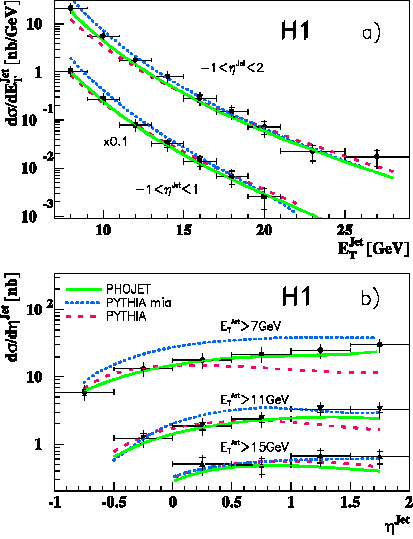 Figure
23. a) Inclusive differential ETjet photoproduction
jet cross sections for ETjet > 7 GeV from H1 for
two h ranges compared with two QCD generators,
PHOJET and PYTHIA, the latter with and without interactions of the beam
remnants. b) Inclusive differential h photoproduction
cross section from H1 compared with the same 3 QCD generators for 3 different
ETjet thresholds49.
Figure
23. a) Inclusive differential ETjet photoproduction
jet cross sections for ETjet > 7 GeV from H1 for
two h ranges compared with two QCD generators,
PHOJET and PYTHIA, the latter with and without interactions of the beam
remnants. b) Inclusive differential h photoproduction
cross section from H1 compared with the same 3 QCD generators for 3 different
ETjet thresholds49.
Figure 23 compares the H1 data with a calculation based on PYTHIA 5.7
event generator for photon-proton interactions. The PYTHIA model without
multiple interactions (dashed line) does not describe the measured cross
sections well at large rapidities and at small transverse energies of the
jets. The PYTHIA model with multiple interactions (dotted line) provides
a good description of the shape of the measured ds/dhjet
cross section, but gives too large a cross section for small Etjet
> 7 GeV, where xg is small (xg
Å 0.1). Figure 23 also compares the H1 data with the PHOJET 1.0 calculation,
which includes multiple interactions, but with softer beam-remnant interactions
than PYTHIA, and adds a characterization of the transition to the nonperturbative
soft-scattering. In addition, while PYTHIA contains hard initial state
parton radiation, PHOJET does not. The PHOJET curves (solid lines) give
a good description of both ds/dETjet
and ds/dhjet
distributions. The differences in these two models and their agreement
with the data lead H1 to conclude that there are uncertainties on the order
of a factor of two in conclusions about the parton content of the photon
drawn from jet cross sections in the low xg region49.
The data support the inclusion of interactions between the beam remnants
since this produces a marked improvement in the agreement with QCD models.
Figure 24 shows the kinematics of dijet production in the dijet center
of mass system and the lab frame. In the dijet CMS, the average pseudo-rapidity
of the two highest ET jets, 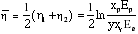 ,
provides information about the structure functions of the photon and proton.
The sensitivity to the incoming particle parton distributions is increased
by the requirement that |Dh| = |h1
- h2| < 0.5. Under these conditions where ETjet1
Å Etjet2, for 2 Æ
2 scattering in LO QCD, we have:
,
provides information about the structure functions of the photon and proton.
The sensitivity to the incoming particle parton distributions is increased
by the requirement that |Dh| = |h1
- h2| < 0.5. Under these conditions where ETjet1
Å Etjet2, for 2 Æ
2 scattering in LO QCD, we have: 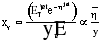 for resolved photoproduction (0.3 < xgOBS
< 0.75, where the lower cut is placed to ensure a well-understood
model) and
for resolved photoproduction (0.3 < xgOBS
< 0.75, where the lower cut is placed to ensure a well-understood
model) and  for direct photoproduction
(xgOBS
> 0.75). This provides an opportunity by separating direct
from resolved photoproduction to present cross sections sensitive to the
gluon distributions in the proton and photon respectively.
for direct photoproduction
(xgOBS
> 0.75). This provides an opportunity by separating direct
from resolved photoproduction to present cross sections sensitive to the
gluon distributions in the proton and photon respectively.
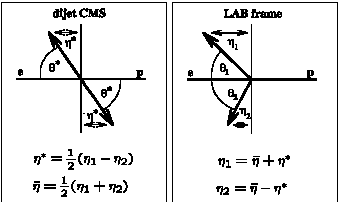 Figure
24. Jet kinematics for ep interactions in the center of mass system and
the lab frame.
Figure
24. Jet kinematics for ep interactions in the center of mass system and
the lab frame.
Figure 25 shows the differential dijet cross section, ds/ ,
from ZEUS integrated above ETjet
= 6 GeV for the central rapidity range, -1.375 < hjet
< 1.875 using three different jet finders. EUCELL and PUCELL are cone
algorithms with radius R =1. EUCELL uses a sliding window in h
and f to define the seed, while PUCELL uses
a calorimeter cell as a seed and merges nearby jets under certain conditions.
KTCLUS is a kT cluster algorithm (see Section 2.5) selected
to closely resemble the cone algorithm in its use of
,
from ZEUS integrated above ETjet
= 6 GeV for the central rapidity range, -1.375 < hjet
< 1.875 using three different jet finders. EUCELL and PUCELL are cone
algorithms with radius R =1. EUCELL uses a sliding window in h
and f to define the seed, while PUCELL uses
a calorimeter cell as a seed and merges nearby jets under certain conditions.
KTCLUS is a kT cluster algorithm (see Section 2.5) selected
to closely resemble the cone algorithm in its use of  and the ET recombination scheme. Also shown is a full NLO QCD
calculation of Klasen and Kramer56 using the GRV
photon and CTEQ proton PDF's for Rsep = 1.0 and 2.0, where Rsep
determines the maximum distance in h-f
at which two partons can be merged into a single
jet. For comparison with KTCLUS and PUCELL, Rsep =1.0 should
be used and for comparison with EUCELL Rsep should be in the
range 1.5 - 2.0. In Figure 25a, the direct photoproduction data is in fairly
good agreement with the theory, particularly when the KTCLUS algorithm
is used, with the exception of the forward rapidity region, where the data
fall systematically above the theory. The choice of jet algorithm has an
effect of about 25-30% for both theory and experiment. In Figure 25b, the
resolved cross section data is above the theory by a factor of two, although
the systematic errors are large and the shape appears to be generally the
same. The choice of jet algorithm has an effect of about 50% in both theory
and experiment.
and the ET recombination scheme. Also shown is a full NLO QCD
calculation of Klasen and Kramer56 using the GRV
photon and CTEQ proton PDF's for Rsep = 1.0 and 2.0, where Rsep
determines the maximum distance in h-f
at which two partons can be merged into a single
jet. For comparison with KTCLUS and PUCELL, Rsep =1.0 should
be used and for comparison with EUCELL Rsep should be in the
range 1.5 - 2.0. In Figure 25a, the direct photoproduction data is in fairly
good agreement with the theory, particularly when the KTCLUS algorithm
is used, with the exception of the forward rapidity region, where the data
fall systematically above the theory. The choice of jet algorithm has an
effect of about 25-30% for both theory and experiment. In Figure 25b, the
resolved cross section data is above the theory by a factor of two, although
the systematic errors are large and the shape appears to be generally the
same. The choice of jet algorithm has an effect of about 50% in both theory
and experiment.
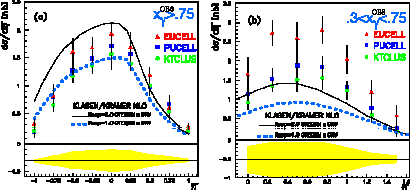 Figure
25. Differential dijet cross section, ds/
Figure
25. Differential dijet cross section, ds/ , for three different jet algorithms from ZEUS for (a) direct photoproduction
and (b) resolved photoproduction. The shaded band indicates the uncertainty
due to the ± 5% uncertainty in the calorimeter energy scale. The
curves are from the full QCD NLO calculations described in the text.
, for three different jet algorithms from ZEUS for (a) direct photoproduction
and (b) resolved photoproduction. The shaded band indicates the uncertainty
due to the ± 5% uncertainty in the calorimeter energy scale. The
curves are from the full QCD NLO calculations described in the text.
The difference between the pseudo-rapidity of the two highest ET jets, h*, where tanh(h*) = tanh(1/2(h1 - h2)) = cos(q*) and q* is the angle between the jet-jet axis and the beam direction in the dijet CMS (see Figure 24), provides information about the spin of the exchanged particle in the interaction. Only the absolute value of cosq* can be measured since the outgoing jets are indistinguishable. As shown in Figure 21 and discussed in Section 3.2, in LO QCD direct photoproduction involves a quark propagator, while resolved photoproduction processes are dominated by gluon propagator. The angular dependence of the cross section for resolved processes with a spin-1 gluon propagator is approximately proportional to (1-|cosq*|)-2, whereas the angular dependence of direct photoproduction with a spin-1/2 quark propagator is approximately proportional to (1-|cosq*|)-1. Therefore, the cross section for resolved processes should rise more steeply with increasing |cosq*| than direct processes. This behavior is also predicted by NLO QCD calculations.
In order to enhance the sensitivity to the parton dynamics, ZEUS makes
a cut on ,
which is a measure of the boost of the dijet scattering system in the HERA
frame, |
,
which is a measure of the boost of the dijet scattering system in the HERA
frame, | | < 0.5. This is in
contrast to the requirement of |Dh| = |h1
- h2| < 0.5 used to enhance the sensitivity of the
dijet cross sections to the incoming parton distributions. In addition,
the dijet angular distributions are studied with a cut on the dijet invariant
mass, Mjj > 23 GeV, where
| < 0.5. This is in
contrast to the requirement of |Dh| = |h1
- h2| < 0.5 used to enhance the sensitivity of the
dijet cross sections to the incoming parton distributions. In addition,
the dijet angular distributions are studied with a cut on the dijet invariant
mass, Mjj > 23 GeV, where  and fjet is the azimuthal angle of
the jet in the HERA frame. For two jets back to back in f
and with equal
and fjet is the azimuthal angle of
the jet in the HERA frame. For two jets back to back in f
and with equal  . In a LO 2 Æ
2 scatter, the dijet invariant mass is related to xp
and xg by
. In a LO 2 Æ
2 scatter, the dijet invariant mass is related to xp
and xg by  .
Therefore, the requirements that the dijet system have high mass and small
boost selects events with gp center-of-mass
energies mostly above 190 GeV and suppresses events with low
.
Therefore, the requirements that the dijet system have high mass and small
boost selects events with gp center-of-mass
energies mostly above 190 GeV and suppresses events with low  .
This produces dijets with good acceptance over a wide range of scattering
angles in a region of xp and xg
where photon and parton distributions are fairly well determined64.
.
This produces dijets with good acceptance over a wide range of scattering
angles in a region of xp and xg
where photon and parton distributions are fairly well determined64.
Figure 26a shows the ZEUS data64 compared to LO and NLO QCD parton level calculations63 using CTEQ3M and GRV (LO)60 PDF's for the proton and photon respectively. The resolved cross section rises more steeply with increasing |cosq*| than the direct cross section. The good agreement between data and theory verifies the expected effects of the spins of the quark and gluon propagators. The same conclusion is drawn from Figure 26b, where the ZEUS data is compared with HERWIG5847 and PYTHIA5742 predictions using the MRSA and GRV (LO)60 PDF's for the proton and photon respectively. The agreement of |cosq*| dependence of the measured cross section with these QCD NLO calculations and Monte Carlo simulations, including parton showering and hadronization models, provides an important confirmation of fundamental aspects of QCD.
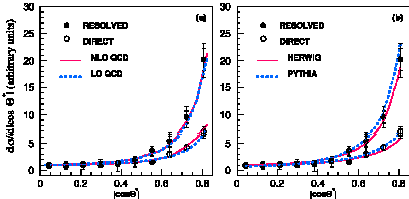 Figure
26. ds/d|cosq*| from
ZEUS64 normalized to one at cosq* = 0 for resolved
(black dots) and direct (open circles) photoproduction. In (a), the data
are compared to a LO (dashed line) and NLO (solid line) QCD prediction.
In (b) the data are compared to PYTHIA (dashed line) and HERWIG (solid
line) distributions. The inner error bars show the statistical errors and
the outer errors bars sum in quadrature the statistical and systematic
errors excluding the energy scale and luminosity uncertainties.
Figure
26. ds/d|cosq*| from
ZEUS64 normalized to one at cosq* = 0 for resolved
(black dots) and direct (open circles) photoproduction. In (a), the data
are compared to a LO (dashed line) and NLO (solid line) QCD prediction.
In (b) the data are compared to PYTHIA (dashed line) and HERWIG (solid
line) distributions. The inner error bars show the statistical errors and
the outer errors bars sum in quadrature the statistical and systematic
errors excluding the energy scale and luminosity uncertainties.
Soft diffractive ep physics involves the study of soft hadronic collisions. These processes have a scale of about 1 fm. An example is pp scattering. The total cross section is approximately constant above 5 GeV. The elastic cross section is a large fraction at low energy (below 1 GeV) and a small fraction at high energy (above 10 GeV). If one models this cross section as a totally absorbing disk, one concludes that the elastic cross section equals the inelastic cross section and corresponds to the optical diffractive or shadow scattering observed when a plane wave impinges on a totally absorbing target, where the angular distribution is the Fourier transform of the target. In the case of the hadronic cross section, as for the optical case, minima occur at angular deflections corresponding to specific values of q2. While the experimental hadronic elastic cross sections display this behavior, their magnitude and dependence on energy do not.
The optical theorem relates the imaginary part of the forward scattering amplitude to the total cross section, Im F(s,t=0) = (q/4p) stot(s). Using the optical theorem with unitarity and analyticity properties of the scattering amplitude leads to the Froissart bound on the scattering amplitude, stot(s) < c (ln[s])2 as s Æ . A useful description of pion-nucleon scattering above the resonance region (Mpp > 3 GeV), where the energy dependence is smooth, is in terms of a t-channel exchange two body scattering process mediated by a single virtual particle (e.g. a pion). However, such a scattering amplitude has dominant poles corresponding to the exchange of particles with a fixed angular momentum, j, producing a dependence EJ in the amplitude that violates the Froissart bound as s Æ .
Regge showed that the usual partial wave decomposition of the scattering
amplitude,  could be extended
to continuous complex angular momenta f(j,k) with physically observable
states for multiples of integral or half-integral angular momentum, j(k),
called Regge poles. Chew and Frautschi extended this to relativistic field
theory where the resonances at these values of angular momentum, j(t),
are organized in a family of particles, with different spin but the same
internal quantum numbers, called Regge trajectories. These turn out to
have a universal slope for both baryons and mesons of the form j(t)
= j(0) + a´t, where a´
Å 1 GeV-2 . Crossing symmetry and the assumption that
an isolated Regge pole at lowest j for space-like t dominates the
amplitude results in a prediction for the asymptotic behavior of the scattering
amplitude in the s-channel, F(s,t) µ
could be extended
to continuous complex angular momenta f(j,k) with physically observable
states for multiples of integral or half-integral angular momentum, j(k),
called Regge poles. Chew and Frautschi extended this to relativistic field
theory where the resonances at these values of angular momentum, j(t),
are organized in a family of particles, with different spin but the same
internal quantum numbers, called Regge trajectories. These turn out to
have a universal slope for both baryons and mesons of the form j(t)
= j(0) + a´t, where a´
Å 1 GeV-2 . Crossing symmetry and the assumption that
an isolated Regge pole at lowest j for space-like t dominates the
amplitude results in a prediction for the asymptotic behavior of the scattering
amplitude in the s-channel, F(s,t) µ
 and ds/dt
= b2(t)s2(a(t)
-1). The forward direction is t = 0, and as we move away from
the forward direction, t becomes negative and ds/dt
decreases exponentially. This forward diffraction peak is an important
feature of elastic scattering. Regge theory predicts that this diffraction
peak should become increasingly narrower at higher s. This is called
shrinkage.
and ds/dt
= b2(t)s2(a(t)
-1). The forward direction is t = 0, and as we move away from
the forward direction, t becomes negative and ds/dt
decreases exponentially. This forward diffraction peak is an important
feature of elastic scattering. Regge theory predicts that this diffraction
peak should become increasingly narrower at higher s. This is called
shrinkage.
A nearly constant total cross section at high s requires a(0) very close to one. Since a single Regge trajectory should account for all elastic scattering at high energy, where no quantum numbers save angular momentum may be exchanged, trajectory must involve the exchange of no quantum numbers except angular momentum and therefore has the quantum numbers of the vacuum. This trajectory is called the Pomeron trajectory, where a(t) = a0 + a´t = 1.085 + 0.25t. Regge Theory provides a good description of total hadronic and photoproduction cross sections.
In 1984, the UA4 experiment at the CERN SPS  collider reported diffractive production of high mass systems at
  = 540 GeV. Ingelman and Schlein suggested that
high-pt jets might be produced in such states and that such
high-pt structure would provide new information about the nature
of pomeron exchange. They suggested the possibility of probing the exchanged
pomeron in a hard scattering process such as between a gluon in the pomeron
and a parton in the proton, which would have the signature of two high-pt
jets and two low-pt remnant or spectator jets. They also pointed
out that if there were a pomeron component in the proton that could be
characterized by an effective structure function, this could be studied
at HERA, where the probe would be well understood and with a clear experimental
signature: "a quasi-elastically scattered proton (going down the beampipe)
well separated from the hadronic system."
= 540 GeV. Ingelman and Schlein suggested that
high-pt jets might be produced in such states and that such
high-pt structure would provide new information about the nature
of pomeron exchange. They suggested the possibility of probing the exchanged
pomeron in a hard scattering process such as between a gluon in the pomeron
and a parton in the proton, which would have the signature of two high-pt
jets and two low-pt remnant or spectator jets. They also pointed
out that if there were a pomeron component in the proton that could be
characterized by an effective structure function, this could be studied
at HERA, where the probe would be well understood and with a clear experimental
signature: "a quasi-elastically scattered proton (going down the beampipe)
well separated from the hadronic system."
Subsequently, the UA8 experiment at the CERN SPS  collider reported jet production in high-mass diffractive final states
that was in good agreement with a hard scattering model with a pomeron
dominated by gluons. They also reported a "super-hard" component
of the pomeron, where it appeared that a "large fraction of the pomeron's
momentum participates in the hard scattering a significant amount of the
time". There have also been recent measurements of diffractive scattering
at the Fermilab Tevatron
collider reported jet production in high-mass diffractive final states
that was in good agreement with a hard scattering model with a pomeron
dominated by gluons. They also reported a "super-hard" component
of the pomeron, where it appeared that a "large fraction of the pomeron's
momentum participates in the hard scattering a significant amount of the
time". There have also been recent measurements of diffractive scattering
at the Fermilab Tevatron  collider.
These are discussed in the article by M. Albrow in these proceedings.
collider.
These are discussed in the article by M. Albrow in these proceedings.
In 1993, ZEUS reported and H1 confirmed DIS events that have an absence of energy deposition in the forward direction. Figure 27 shows an event observed in the ZEUS detector with no significant deposit of energy beyond q > 90°. The figure also shows the lines of pseudorapidity, h, at the boundary of the ZEUS forward, barrel and rear calorimeters. Events with a large region in h with no energy deposits are called large rapidity gap events (LRG). In order to quantify the absence of energy in the detector, the ZEUS analysis defines a calorimeter cluster as an isolated set of adjacent cells with summed energy above 400 MeV. The h of the cluster closest to the forward direction, i.e. the highest h value, is called hmax. Figure 28 shows the hmax distribution of DIS events from ZEUS. There are two groups of events, one with large hmax values, and the other with hmax < 2. Also shown is the standard ZEUS DIS MC, which agrees with the data for hmax < 2, but not for hmax < 2, where there is a clear excess of events with large rapidity gaps, corresponding to ~ 10% of the total DIS cross section.
A natural interpretation of these events is that they are due to diffractive
scattering of the virtual photon from the proton. This means that the proton
does not fragment into a visible system of hadrons either because it remains
intact or dissociates into a system which is closely confined to the proton
direction. In addition, there is no appreciable amount of initial state
QCD radiation, because that would also have produced hadrons visible in
the forward calorimeter.
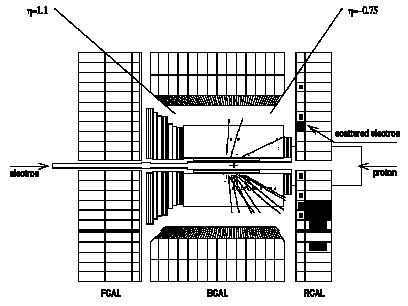 Figure
27. A ZEUS DIS event at Q2=64 GeV2 with a large rapidity
gap.
Figure
27. A ZEUS DIS event at Q2=64 GeV2 with a large rapidity
gap.
Figure 29 shows a schematic picture of DIS events with no rapidity gap (NRG) and with a large rapidity gap (LRG). A typical NRG event has the phase space filled between the current jet and the proton remnant filled with particles produced by the emission of additional gluons and quarks created by the color flow between the struck quark and the proton remnant. An explanation for the LRG events is the emittance of a color neutral particle from the proton, which interacts with the exchanged virtual photon. In this case, there is no color flow that would produce particles between the struck quark and the proton remnant. Since diffraction is considered to proceed by the exchange of a pomeron, with the quantum numbers of the vacuum, a model of the LRG events is to assume a flux of pomerons in the proton. Figure 28 shows the prediction of DIS model with a diffractive component (POMPYT) modeled by a flux of pomerons (where the pomeron is considered to be composed of gluon constituents typically carrying a large fraction of the pomeron's momentum), which does agree for all values of hmax.
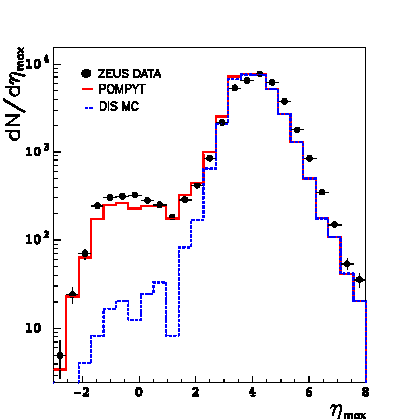 Figure
28. Distribution of the maximum rapidity hmax
of a calorimeter cluster in ZEUS DIS events for data (points), the standard
DIS MC, and MC calculations (POMPYT) adding a diffractive component to
the standard DIS processes.
Figure
28. Distribution of the maximum rapidity hmax
of a calorimeter cluster in ZEUS DIS events for data (points), the standard
DIS MC, and MC calculations (POMPYT) adding a diffractive component to
the standard DIS processes.
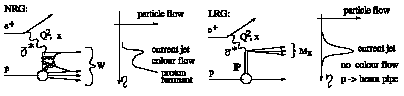 Figure
29. Comparison of ep events with no rapidity gap (NRG) and with
a large rapidity gap (LRG), showing the absence of the particle and color
flow in LRG events.
Figure
29. Comparison of ep events with no rapidity gap (NRG) and with
a large rapidity gap (LRG), showing the absence of the particle and color
flow in LRG events.
Diffractive ep scattering provides the opportunity to explore the interplay of soft and hard QCD processes as well as to investigate the structure of the pomeron. Soft hadronic processes occur on the scale of ~ 1 fm and are characterized by the pomeron trajectory as described in section 4.1. Hard QCD processes such as DIS, including hard diffraction, have their hard scale determined by the virtuality of the photon or jets and the soft scale set by the size of the proton of ~ 1 fm. In order to apply perturbative QCD to hard processes, the hard scale physics must factorize from the soft scale physics. This factorization, which allows the two scales of physics to be considered separately, is an assumption used to produce the DGLAP evolution equations described in section 2.2.3.
Important distinguishing features of hard and soft QCD processes are the energy and t-dependence of the scattering cross sections and their variation with Q2 or W2. Another interesting question is the partonic structure of the pomeron. This can be investigated by comparison with various models treating the parton as composed of combinations of soft and hard quarks and gluons. Another approach is to treat the pomeron as a quasi-hadron with a flux factor and under diffractive conditions to replace the proton structure function by a diffractive structure function. Another indication of pomeron partonic structure would be jet production in diffractive events. Each of these aspects is discussed below.
Figure 30 shows the definition of the kinematic variables used in ep
scattering. The square of the momentum transfer at the proton vertex is
t = (p - p¢)2, where p¢
is the 4-momentum of the outgoing proton, or if the proton dissociates,
the 4-momentum of the outgoing system. The pomeron carries momentum IP,
with a fraction of the proton momentum xIP. MX is
the invariant mass of the hadronic system produced from the photon dissociation.
b is the fraction of the pomeron momentum carried
by the parton in the pomeron that interacts with the virtual photon, in
analogy to the definition of x defined for the proton in DIS.
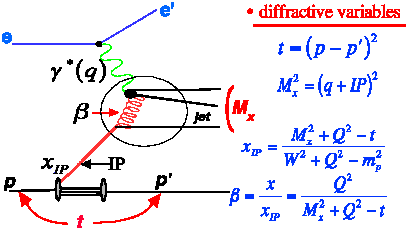 Figure
30. Definition of kinematics for diffractive ep scattering.
Figure
30. Definition of kinematics for diffractive ep scattering.
For unpolarized beams, the differential cross section for single diffractive
dissociation can be described in terms of a diffractive structure function, ,
where an integration has been performed over t, corresponding to the (undetected)
momentum transfer to the undetected momentum transfer to the proton system,
the effect of FL has been neglected and the relation x
= bxIP has been used. In the
model of Ingelman and Schlein75 the proton emits a pomeron which is treated
as a virtual hadron whose structure is probed by the virtual photon. The
pomeron is described by a structure function,
,
where an integration has been performed over t, corresponding to the (undetected)
momentum transfer to the undetected momentum transfer to the proton system,
the effect of FL has been neglected and the relation x
= bxIP has been used. In the
model of Ingelman and Schlein75 the proton emits a pomeron which is treated
as a virtual hadron whose structure is probed by the virtual photon. The
pomeron is described by a structure function, ,
which is independent of the process of pomeron emission. Therefore,
,
which is independent of the process of pomeron emission. Therefore,  factorizes as:
  , where
  is the flux of pomerons in the proton, which can be extracted from hadron-hadron
scattering within an uncertainty of about 30%. diffractive. Regge theory
predicts that if the xIP dependence corresponds to a
flux of pomerons associated with the proton, then
is the flux of pomerons in the proton, which can be extracted from hadron-hadron
scattering within an uncertainty of about 30%. diffractive. Regge theory
predicts that if the xIP dependence corresponds to a
flux of pomerons associated with the proton, then  ,
where n = 2a(t) - 1, and a(t)
= a(0) + a¢t
is the pomeron trajectory. The first measurements of
,
where n = 2a(t) - 1, and a(t)
= a(0) + a¢t
is the pomeron trajectory. The first measurements of  by H1 and ZEUS established the attribution of the rapidity gap events to
a virtual photon-proton process that was dominantly diffractive. Figure
31 shows a recent measurement of
by H1 and ZEUS established the attribution of the rapidity gap events to
a virtual photon-proton process that was dominantly diffractive. Figure
31 shows a recent measurement of  by H1 as a function of xIP
for different values of b and Q2.
The data is compared to a fit of the form (xIP)-n(b)
with the normalization in each bin determined by the factor A(b,Q2).
by H1 as a function of xIP
for different values of b and Q2.
The data is compared to a fit of the form (xIP)-n(b)
with the normalization in each bin determined by the factor A(b,Q2).
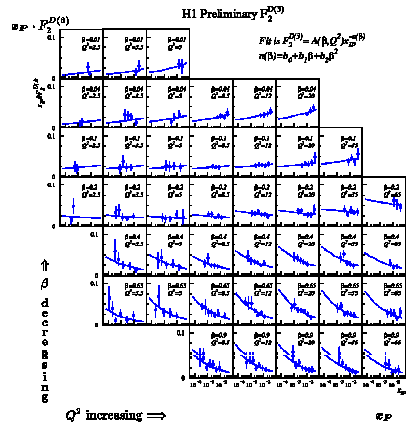 Figure
31. Preliminary measurement of
Figure
31. Preliminary measurement of  by H1 as a function of xIP in bins of Q2 and
b with statistical and systematic errors added
in quadrature. The curves are from the overall parameterization of the
xIP dependence described in the text.
by H1 as a function of xIP in bins of Q2 and
b with statistical and systematic errors added
in quadrature. The curves are from the overall parameterization of the
xIP dependence described in the text.
Figure 32a shows the H186 result from fitting the data of Figure 31
to the polynomial dependence  , where n is allowed to vary with b, but not
with Q2. The value of n decreases markedly with
b for b 2 0.3, which shows that the expectation
of factorization of
, where n is allowed to vary with b, but not
with Q2. The value of n decreases markedly with
b for b 2 0.3, which shows that the expectation
of factorization of  is not
valid over the full kinematic range. However, H1 note that these deviations
from factorization are consistent with a contribution to
is not
valid over the full kinematic range. However, H1 note that these deviations
from factorization are consistent with a contribution to  from meson exchange. An example of such a meson trajectory would be the
 , which would have n ~ 0 and
possibly a much softer b dependence than the
pomeron trajectory. Figure 32b shows the result where n is allowed to vary
with Q2, but not with b. There is
no evidence for dependence of b on Q2.
, which would have n ~ 0 and
possibly a much softer b dependence than the
pomeron trajectory. Figure 32b shows the result where n is allowed to vary
with Q2, but not with b. There is
no evidence for dependence of b on Q2.
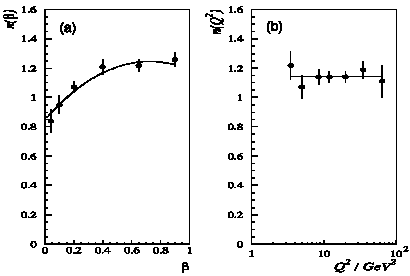 Figure
32. Preliminary H1 results from fitting
Figure
32. Preliminary H1 results from fitting  to the form
  . In (a) n is allowed
to vary with b, but not with Q2.
In (b), n is allowed to vary with Q2
but not with b. The error bars include statistical
and systematic uncertainties folded in quadrature.
. In (a) n is allowed
to vary with b, but not with Q2.
In (b), n is allowed to vary with Q2
but not with b. The error bars include statistical
and systematic uncertainties folded in quadrature.
In spite of the lack of factorization of the measured diffractive cross section over the entire kinematic range, integrating over xIP produces a measurement of the average deep inelastic structure of the total colorless isospin conserving exchanges involved.
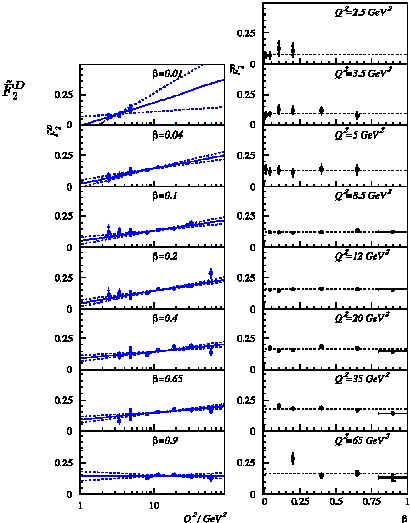 Figure
33. Preliminary measurement by H1 of
Figure
33. Preliminary measurement by H1 of as a function of Q2 for different b
values (left) and as a function of b for different
Q2 values (right). The solid lines
in the Q2 plots are the best fit to a linear dependence on lnQ2,
with dashed lines at ± 1s. The dashed
lines in the b plots show a constant dependence
on b.
as a function of Q2 for different b
values (left) and as a function of b for different
Q2 values (right). The solid lines
in the Q2 plots are the best fit to a linear dependence on lnQ2,
with dashed lines at ± 1s. The dashed
lines in the b plots show a constant dependence
on b.
H1 defines86 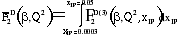 . Figure 33
shows
. Figure 33
shows  from H1 as a function
of Q2 for fixed b and as a function
of b for fixed Q2. At fixed Q2
from H1 as a function
of Q2 for fixed b and as a function
of b for fixed Q2. At fixed Q2
 shows little dependence on
b. The dependence of
shows little dependence on
b. The dependence of  on Q2 shows clear evidence of scaling violation. Most notable
is the persistence of the rise with lnQ2 that persists to values
of b beyond the point where the proton structure
function is dominated by valence quarks (x ~ 0.15) and not by gluons.
These scaling violations are in agreement with a picture where there is
a substantial gluon contribution to the diffractive exchange. H1 have performed
a QCD analysis of
on Q2 shows clear evidence of scaling violation. Most notable
is the persistence of the rise with lnQ2 that persists to values
of b beyond the point where the proton structure
function is dominated by valence quarks (x ~ 0.15) and not by gluons.
These scaling violations are in agreement with a picture where there is
a substantial gluon contribution to the diffractive exchange. H1 have performed
a QCD analysis of  using DGLAP
evolution and conclude that at Q2 = 5 GeV, "leading"
gluon behavior is seen, where the exchange is mostly taking place through
gluons carrying a large (> 0.9) fraction of the pomeron's momentum)
and that throughout the observed Q2 range from 5 to 65 GeV2
more than 80% of the momentum transfer in the diffractive exchange
is due to gluons with a decreasing fraction with increasing Q2.
using DGLAP
evolution and conclude that at Q2 = 5 GeV, "leading"
gluon behavior is seen, where the exchange is mostly taking place through
gluons carrying a large (> 0.9) fraction of the pomeron's momentum)
and that throughout the observed Q2 range from 5 to 65 GeV2
more than 80% of the momentum transfer in the diffractive exchange
is due to gluons with a decreasing fraction with increasing Q2.
ZEUS has uses its Leading Proton Spectrometer (LPS) to measure scattered
protons with small transverse momenta (pT < 1 GeV) with respect
to the proton beam direction. The LPS provides a direct measurement of
xL = p¢/pbeam with
0.4% resolution at pbeam = 820 GeV, as well as xIP
~ 1 - xL and 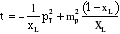 .
This provides the opportunity to directly measure t with a resolution
~ 30%, dominated by the transverse spread in the proton beam. The identification
of single diffractive events (where the proton remains intact) by the presence
of rapidity gaps results in considerable backgrounds from non-diffractive
DIS of up to 50% and proton dissociation (where the proton does not remain
intact) of 10-15% (estimated from hadron scattering data). Figure 34 shows
the xL distribution for ZEUS data,
compared with MC calculations of events from diffraction (RAPGAP) and the
backgrounds from non-diffractive DIS, pion exchange and proton dissociation.
There is excellent agreement between the model and the data with a clear
diffractive peak at high xL. The backgrounds peak at
low xL values. Therefore, the LPS enables the selection
of a clean sample of diffractive events by requiring xL >
0.97, with a uniform acceptance in xL, after averaging
over azimuthal angle, of 6%. The remaining background for xL
> 0.97 is estimated to be ~ 5% and is subtracted from the subsequent
LPS results.
.
This provides the opportunity to directly measure t with a resolution
~ 30%, dominated by the transverse spread in the proton beam. The identification
of single diffractive events (where the proton remains intact) by the presence
of rapidity gaps results in considerable backgrounds from non-diffractive
DIS of up to 50% and proton dissociation (where the proton does not remain
intact) of 10-15% (estimated from hadron scattering data). Figure 34 shows
the xL distribution for ZEUS data,
compared with MC calculations of events from diffraction (RAPGAP) and the
backgrounds from non-diffractive DIS, pion exchange and proton dissociation.
There is excellent agreement between the model and the data with a clear
diffractive peak at high xL. The backgrounds peak at
low xL values. Therefore, the LPS enables the selection
of a clean sample of diffractive events by requiring xL >
0.97, with a uniform acceptance in xL, after averaging
over azimuthal angle, of 6%. The remaining background for xL
> 0.97 is estimated to be ~ 5% and is subtracted from the subsequent
LPS results.
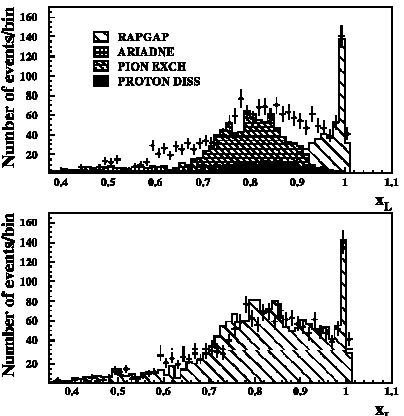 Figure
34. xL = p¢/pbeam
distribution for ZEUS data compared with individual (upper plot) and summed
(lower plot) MC calculations of events from DIS (ARIADNE), pion exchange,
proton dissociation and diffraction (RAPGAP).
Figure
34. xL = p¢/pbeam
distribution for ZEUS data compared with individual (upper plot) and summed
(lower plot) MC calculations of events from DIS (ARIADNE), pion exchange,
proton dissociation and diffraction (RAPGAP).
Figure 35 shows the ZEUS LPS measurement of the t-dependence
of diffractive DIS events measured in the kinematic range 4 < Q2
< 30 GeV2, 70 < W2 < 210 GeV2,
0.02 < b < 0.4 and xL >
0.97. The bin width in t was selected to be larger than the resolution,
producing 4 bins in the range 0.07 < |t| < 0.35 GeV2.
The distribution was fit to a single exponential of the form ds/d|t|
~ e-b|t| and is shown in Figure 35 as a solid line. The value
of the fitted slope parameter 
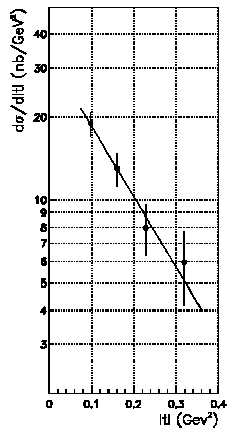 Figure
35. Differential cross section ds/d|t| from
ZEUS for diffractive DIS events with a tagged leading proton having xL
> 0.97, along with an exponential fit described in the text. The error
bars include statistical and systematic errors added in quadrature.
Figure
35. Differential cross section ds/d|t| from
ZEUS for diffractive DIS events with a tagged leading proton having xL
> 0.97, along with an exponential fit described in the text. The error
bars include statistical and systematic errors added in quadrature.
Figure 36 shows the ZEUS measurement88 of the diffractive structure
function,  , integrated over
t due to the limited statistics, as a function of xIP
in bins of b for 0.006 < b
< 0.5, 4 x 10⁻⁴ < xI < 3 x 10⁻²
and 4 < Q2 < 20 GeV2 with a central value of
Q2 = 12 GeV2. In order to investigate whether the
factorization of
, integrated over
t due to the limited statistics, as a function of xIP
in bins of b for 0.006 < b
< 0.5, 4 x 10⁻⁴ < xI < 3 x 10⁻²
and 4 < Q2 < 20 GeV2 with a central value of
Q2 = 12 GeV2. In order to investigate whether the
factorization of  holds, fits
were performed in the highest 3 b bins to the
form Ai(1/xIP)a, where the normalization
constants Ai were allowed to vary in each bin. A very good fit
is obtained (c2 of 10 for 11 degrees
of freedom) in all 3 b bins with the value a
= 1.28 ± 0.07 (stat.) ± 0.15 (syst.) Therefore,
this result is compatible with factorization, which is significant considering
the removal of backgrounds, particularly that of meson exchange, that could
affect the H1 result.
holds, fits
were performed in the highest 3 b bins to the
form Ai(1/xIP)a, where the normalization
constants Ai were allowed to vary in each bin. A very good fit
is obtained (c2 of 10 for 11 degrees
of freedom) in all 3 b bins with the value a
= 1.28 ± 0.07 (stat.) ± 0.15 (syst.) Therefore,
this result is compatible with factorization, which is significant considering
the removal of backgrounds, particularly that of meson exchange, that could
affect the H1 result.
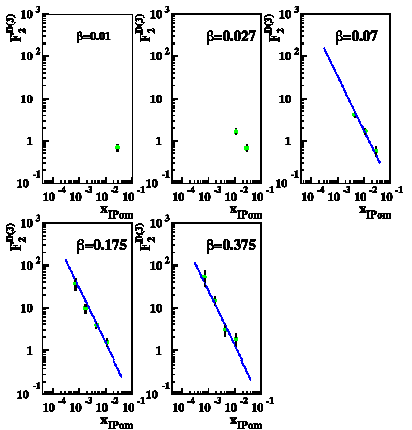 Figure
36. The diffractive structure function
Figure
36. The diffractive structure function  from ZEUS, plotted as a function of xIP in 5 bins of
b at Q2 = 12 GeV2 compared with a fit described
in the text. The errors are statistical only.
from ZEUS, plotted as a function of xIP in 5 bins of
b at Q2 = 12 GeV2 compared with a fit described
in the text. The errors are statistical only.
Diffractive hard photoproduction in ep collisions occurs with
Q2 Å 0 and a final state hadronic system containing at
least one jet. ZEUS has examined dijet photoproduction events with a forward
rapidity gap. Figure 37a shows a schematic
representation of such an event that proceeds via pomeron exchange at small
t. The indicator of the photon dissociation is the final state proton's
retention of a large fraction of the original longitudinal momentum.
A large rapidity gap between the hadronic system and the scattered
proton is produced by the exchange of a colorless object, i.e. the
pomeron. The typical topology of a diffraction dijet photoproduction event
is shown in Figure 37b.
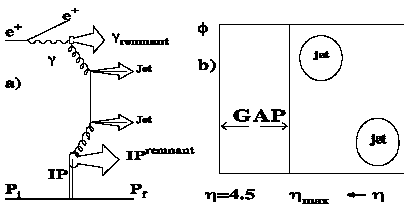 Figure
37. a) Example of a two-jet diffractive process via pomeron exchange at
small t. b) Typical topology of the event in a) as seen by ZEUS.
Figure
37. a) Example of a two-jet diffractive process via pomeron exchange at
small t. b) Typical topology of the event in a) as seen by ZEUS.
ZEUS has measured90 the dijet cross section for photoproduction events with the most forward-going hadron at h < 1.8, where the jets have |hjet| < 1.5 and transverse energy, Etjet > 6 GeV, where Q2 < 4 GeV2 and 0.2 < Eg/Ee < 0.8, corresponding to photoproduction interactions with a center of mass energy in the range 134 - 269 GeV and a median Q2 Å 10-3 GeV2. This data has been compared with a factorizable Ingelman-Schlein (IS) model where a parton from the pomeron can directly scatter off the photon (direct photoproduction) or with a parton from the photon (resolved photoproduction). The flux of pomerons in the proton is given by a parameterization of UA4 data. A second model from Donnachie and Landshoff (DL) calculates the pomeron flux from fits to hadron-hadron data. The IS and DL pomeron flux factors give similar results. ZEUS explored the effects of four different expressions for the density of partons in the pomeron in terms of b, the momentum fraction of the struck parton in the pomeron:
These were implemented in the framework of the POMPYT80 model.
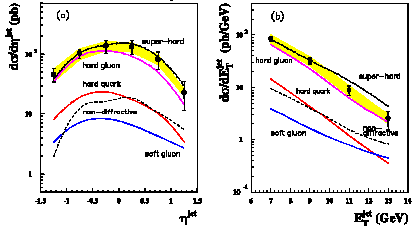 Figure
38. ZEUS differential dijet photoproduction cross section as a function
of (a) hjet and (b) ETjet.
The thick error bars show the statistical error and the thin error bars
show the statistical and systematic errors added in quadrature (excluding
the jet energy scale error shown as a band). The data are compared with
the POMPYT model using the inputs described in the text and with a calculation
of the non-diffractive component.
Figure
38. ZEUS differential dijet photoproduction cross section as a function
of (a) hjet and (b) ETjet.
The thick error bars show the statistical error and the thin error bars
show the statistical and systematic errors added in quadrature (excluding
the jet energy scale error shown as a band). The data are compared with
the POMPYT model using the inputs described in the text and with a calculation
of the non-diffractive component.
The ZEUS corrected differential dijet cross section ds/dhjet
with the cuts described above is shown in Figure 38a. The cross section
is flat in the central region and falls off as the jets approach the beam
direction. The transverse energy differential cross section, ds/dETjet
is shown in Figure 38b. The cross section falls off exponentially as a
function of Etjet. The figure shows that the expectation
of the non-diffractive contribution caused by fluctuations in the final
hadron system and estimated using PYTHIA including both direct and resolved,
is 3-8 times below the data for ds/dETjet
and 7 times for ds/dhjet.
Figure 38 also shows the diffractive model predictions using POMPYT, the
DL pomeron flux and the parton distributions in the pomeron listed above.
The soft gluon density pomeron parton distribution neither matches the
data in shape nor normalization. The hard quark density describes the shape,
but falls below the data. The hard and super-hard gluon densities provide
reasonable descriptions of the data both in shape and magnitude.
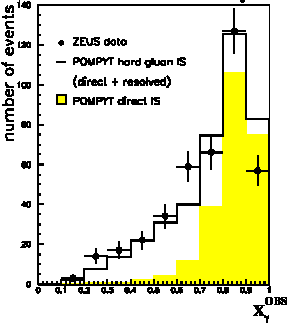 Figure
39. xgOBS distribution
from ZEUS for diffractive photoproduction of dijets. The solid line shows
POMPYT with resolved and direct contributions for a hard gluon density
in the pomeron. The direct contribution is shown as the shaded area.
Figure
39. xgOBS distribution
from ZEUS for diffractive photoproduction of dijets. The solid line shows
POMPYT with resolved and direct contributions for a hard gluon density
in the pomeron. The direct contribution is shown as the shaded area.
Figure 39 shows the xgOBS distribution from ZEUS for diffractive photoproduction of dijets with the cuts described above. The xgOBS distribution peaks at xgOBS = 0.85 with a large tail at low xgOBS. The background from non-diffractive hard photoproduction, as calculated from PYTHIA, is estimated to be about 18 ± 4 % and is concentrated at large xgOBS values, so it cannot account for the amount of the data nor the low xgOBS tail. The dependence of the relative amounts of direct and resolved contributions to standard hard photoproduction is predicted to depend on the jet transverse energy. The resolved contribution is expected to dominate over the direct in the Etjet range of this sample. However, due to the limited center of mass energy, the direct contribution is expected to be enhanced90. Figure 39 shows that the sum of the direct and resolved contributions as predicted by POMPYT (histogram) with the hard gluon pomeron parton density and IS pomeron flux give a reasonable description of the data. In contrast, the prediction of the purely direct photoproduction contribution (shaded area) does not reproduce the data. This remains true when a hard quark density is used. Therefore one can conclude that resolved diffractive photoproduction is being observed.
The HERA collider and the H1 and ZEUS experiments have unearthed a rich source of information on the structure of the proton and the photon. The extension of the range of the proton structure function measurements by two order of magnitude has uncovered the dramatic rise in F2 with decreasing x at low x that indicates a large increase in the gluon density. At low Q2, we are observing the transition from perturbative QCD to the soft hadronic physics described by Regge theory. Studies of deep inelastic multijet events have shown the value and running of the strong coupling constant over a large Q2 range within a single experiment. The observation of resolved and direct photoproduction, particularly in dijets has provided new insight into the structure of the photon as well as the spin of the exchanged parton in these processes. The discovery of diffraction in ep collisions both in deep inelastic scattering and in photoproduction has produced information about the structure of the pomeron and the characteristics of the diffractive process.
The future for the HERA program looms particularly bright. While all
of the above physics discussed in these lectures is based on data samples
up through 1995 of around 10 pb-1, the DESY Directorate
has endorsed an upgrade plan for HERA that should yield luminosities of
150 pb-1/year, with polarized electrons and positrons,
beginning in the year 2000. Already the 1996 run with positrons is expected
to yield more than 10 pb-1, with more improvements expected
in 1997 and beyond, including switching to electrons in 1998. This large
increase in luminosity should yield substantial physics results in all
realms of HERA physics. We can look forward to a much deeper understanding
of the structure of the proton and photon, and maybe even some surprises.
Acknowledgments
I am very grateful for the help of many people from H1 and ZEUS who
assisted me in the preparation of these lectures with information, figures,
references and advice. In particular, I would like to thank E. Barberis,
V. Boudry, J. Bulmahn, A. Caldwell, R. Cross, J. Dainton, S. Dasu, R. Eichler,
L. Feld, C. Foudas, E. Gallo, G. Grindhammer, G. Iacobucci, S. Magill,
A. Mehta, S. Mattingly, S. Nam, P. Newman, A. Quadt, D. Reeder, J. Repond,
S. Ritz, R. Sacchi, F. Sciulli, B. Surrow, S. Tapprogge, T. Trefzger, and
many others. I would like to thank the DESY Directorate for their strong
support and encouragement of the HERA program. I would also like to thank
the HERA machine group for their operation of the collider and the computing
staff for the data analysis environment. Finally, I would like to thank
the organizers of the SLAC Summer school for continuing their fine tradition
of superb meetings.